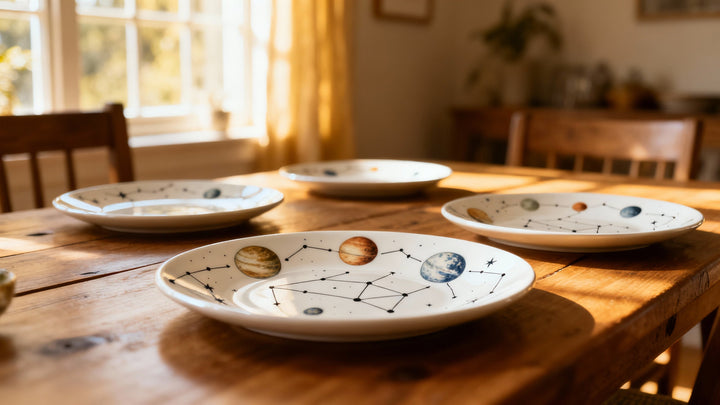


Imagine lighting a candle, setting out your favorite hand-glazed plates, and placing a smart mug that quietly keeps your tea at the perfect sipping temperature. It looks like a gallery-worthy tablescape, yet inside that minimal little mug is the same class of electronics that power phones, cars, and even AI servers. When those chips are in short supply, the ripple reaches all the way to your colorful, carefully curated table.
As a colorful tabletop creative and pragmatic joy curator, I live at the intersection of glaze, glow, and gigabytes. Over the past few years, I have watched smart ceramic dinnerware shift from “fun extra” to “very hard to produce” as chip shortages collided with an already stretched ceramic supply chain. Understanding what is going on behind the scenes helps you choose pieces that still spark joy, even when semiconductors are scarce.
From Glazed Beauty to Glowing Pixels: What Is Smart Ceramic Dinnerware?
Smart ceramic dinnerware is what happens when traditional ceramic artistry meets sensors, chips, and software. Think porcelain plates that can weigh portions and talk to a nutrition app, serving dishes that keep food at a safe temperature, or mugs that log your hydration and nudge you gently when you have not touched your drink in a while.
Market analysts such as Mordor Intelligence estimate that the global ceramic tableware market will be worth about $18.82 billion in 2025 and grow to around $26.13 billion by 2030, at a compound annual growth rate of about 6.21 percent, with Asia-Pacific both the largest and fastest-growing region. Another market forecast focused on luxury tableware values that premium slice alone at roughly $4.44 billion in 2024, rising to about $6.71 billion by 2033. Within that space, one report notes that ceramic products already account for about 41 percent of global luxury tableware volume.
Inside these markets, digital integration is changing how brands design, make, and sell. Research highlighted by a global tableware forecast describes virtual showrooms, rapid prototyping, and smart tableware with embedded sensors for temperature and usage tracking. In other words, smart ceramic dinnerware is not science fiction; it is one of the most exciting edges of an already growing category.
The Tiny Brains Inside Your Plate: Chips and MLCCs
Under the glaze, smart dinnerware is built on the same electronic ingredients used across consumer electronics and cars. Two groups matter most for our story: semiconductor chips and multilayer ceramic chip capacitors, or MLCCs.
Semiconductor chips are the tiny “brains and memory” of digital life. The New York Times has described how these components act as the control centers in everything from smartphones and game consoles to modern cars. They run firmware for a smart mug, handle wireless communication, manage power, and interpret data from sensors.
MLCCs, by contrast, are passive components. A TechDesign analysis explains that passive parts such as resistors, capacitors, and inductors support active components by shaping signals and stabilizing power, rather than actively switching current the way transistors do. Among these, MLCCs—miniature ceramic capacitors that stack thin ceramic and metal layers—have become the workhorses of modern electronics. They tolerate high temperature and voltage, perform well at high frequencies, can be manufactured in tiny sizes, and are suitable for low-cost, high-volume production. Advances in ceramic film stacking mean that extremely small MLCC packages can still deliver large capacitance, allowing them to replace many older capacitor types in compact devices.
You never see them, but you are surrounded by them. A single high-end smartphone typically contains more than 1,000 MLCCs. A conventional car uses around 2,000 passive components in total, while an electric or self-driving car can need 10,000 to 15,000 MLCCs. AI servers can use several thousand MLCCs each. Every one of those capacitors uses ceramic materials and competes for capacity at the same manufacturers that supply the general-purpose components inside a smart dinner plate.
Where These Components Hide in Your Tableware
When I crack open a failed smart mug in the studio (strictly post-mortem, never mid-dinner), the recipe is familiar. There is a ceramic shell, a small printed circuit board, some sensors tucked near the base or handle, a battery, and often a wireless module.
The chips on that board are usually:
- A microcontroller or system-on-chip to run control logic and talk to an app.
- A wireless chip to handle Bluetooth or Wi‑Fi.
- Power-management chips to charge and protect the battery.
- Optional sensors such as temperature probes, weight sensors, or touch sensors.
Sprinkled all around are MLCCs. They smooth power, filter noise, and help keep the whole circuit stable. They are tiny, anonymous, and absolutely essential. Once you understand that, the connection between global chip shortages and whether your favorite smart mug ships on time becomes much more obvious.

How the Global Chip Shortage Came to Your Dining Room
From roughly 2020 through 2023, the world experienced a severe semiconductor shortage that rippled through nearly every industry. BCC Research notes that the shortage lasted about two years and significantly disrupted sectors from automotive to healthcare and computing. It was serious enough to delay the launch of Apple’s iPhone 12 by two months and contributed to an estimated $100 billion in lost revenue for the automotive industry in 2021 alone. Another analysis from AGS Devices estimates that automakers lost closer to $210 billion, underscoring just how painful the bottleneck became.
Several forces collided. COVID-19 shutdowns hit factories early in the pandemic, while demand for laptops, monitors, routers, gaming consoles, and servers surged as people worked and learned from home. Some automakers cut chip orders during the early slump, then were forced to scramble back into line once demand for vehicles rebounded. A New York Times piece on the shortage highlighted how, by the time automakers tried to increase orders, chip foundries had already reallocated capacity to consumer electronics customers and could not pivot quickly.
Chip production is also highly concentrated. Research from industry sources summarized by AGS Devices and Sourceability shows that over 75 percent of global chip production is located in East Asia, with more than 60 percent of advanced chips made in Taiwan. Sourceability reports that TSMC alone manufactures about 60 percent of the world’s chips and around 90 percent of advanced semiconductors. Earthquakes in Japan and Taiwan, winter storms in Texas, and health crises have all previously disrupted semiconductor plants. When a handful of regions and companies carry so much of the world’s chipmaking capacity, any shock—pandemic, natural disaster, or geopolitical conflict—tends to cascade.
The chip ecosystem is also wrestling with booming new demand. BCC Research points to AI chips, 5G rollouts, and connected vehicles as major growth engines. The GSMA has projected that about one third of the world’s population will be covered by 5G networks by 2025, enabling more connected devices. At the same time, the Russia–Ukraine war introduced upstream risks: Russia supplies a large share of global palladium and Ukraine provides the majority of neon gas used in chip manufacturing, creating uncertainty around raw material costs and stability.
Despite all of this volatility, BCC Research still forecasts the semiconductor market growing from about $585.4 billion in 2022 to $882.1 billion by 2027, with an estimated 8.5 percent annual growth rate. Governments are responding with industrial policy. Forbes has reported that the U.S. CHIPS and Science Act commits roughly $52 billion to support domestic semiconductor manufacturing and research, already catalyzing tens of billions of additional private investment. Similar efforts are underway in Europe and Asia.
The short version: chips are in long‑term high demand, production is geographically concentrated and expensive to expand, and the entire ecosystem is under pressure. Smart ceramic dinnerware sits further down this same supply chain.

Why Smart Ceramic Dinnerware Is Especially Exposed
Smart dinnerware producers are not ordering billions of chips like a phone giant, but they are buying from the same global supply pool. That creates a few specific vulnerabilities.
MLCC Bottlenecks and General-Purpose Parts
The MLCC market has had its own drama. TechDesign traces a major MLCC shortage to several factors: Japanese manufacturers like Murata and Taiyo Yuden shifted capacity away from general-purpose MLCCs toward higher-end versions for automotive, industrial, and top-tier smartphones starting around 2016. At the same time, demand from phones and automotive electronics surged. Because the manufacturing equipment for MLCCs has long lead times—around eight to twelve months—supply could not expand quickly.
Several manufacturers responded by raising prices by roughly 40 to 50 percent starting in 2018 and reported component lead times stretching to about 20 weeks. They prioritized large electronics manufacturers, leaving smaller device makers increasingly reliant on distributors and e‑markets rather than direct relationships with primary vendors.
Hongda and other MLCC-focused analyses highlight how electric vehicles, 5G base stations, and AI servers have created a new wave of demand. A typical high-end smartphone now uses more than 1,000 MLCCs, and each electric vehicle may require tens of thousands. AI servers can consume several thousand more. When smart ceramic dinnerware needs comparatively modest volumes of general-purpose MLCCs, it is competing with far larger, higher-priority customers.
Geographic Concentration and Natural-Disaster Risk
Because so much chip and MLCC capacity sits in East Asia, local shocks hit even small lifestyle brands half a world away. Sourceability’s polling found that 41 percent of respondents saw supply chain disruptions as the semiconductor industry’s biggest challenge, ahead of regulation or workforce issues. Earthquakes in Japan, storms in the United States, and maintenance shutdowns in key gas or materials facilities have all triggered temporary shortages.
On the ceramic side, the situation can be just as fragile. Research Dive’s global ceramics market report notes that ceramics are produced for sectors ranging from construction and electronics to healthcare and consumer goods, with a market size of about $242.1 billion in 2022 projected to reach $403.4 billion by 2032 at a 5.5 percent annual growth rate. That same review and other trade coverage describe how COVID-19 caused factory closures, labor shortages, and raw-material bottlenecks, particularly for energy-intensive products like tiles and sanitaryware.
A business article from South Asia on ceramic exports describes gas supply as a critical “raw material” for firing, with factories forced to run at around half capacity when gas pressure falls. Every time a kiln is shut down and restarted, it risks quality issues and wasted product. While that story is about tiles and tableware for export, not specifically smart sets, the energy dependency is the same. If there is not enough gas to fire plates, there will not be enough plates to embed electronics into.
AI, 5G, and the Smart Home Surge
Smart ceramic dinnerware is part of a broader wave of connected devices. BCC Research points out that AI chips and 5G deployment are expanding chip demand into everything from public safety to connected cars. Hongda’s MLCC review notes that 5G base stations and the internet of things—from smart homes to wearables—are adding sustained demand for high-performance MLCCs.
Tableware lives in this same ecosystem. Finance and market analyses describe smart tableware with embedded sensors for temperature and usage tracking as one part of a digitized home and hospitality environment. That means your smart mug is competing not only with phones and cars, but also with smart thermostats, wearables, and an expanding list of connected kitchen gadgets for chips and board space at contract manufacturers.
What You Actually Feel at the Table
From a design and manufacturing standpoint, the chip and MLCC crunch is a complex web of capacity planning, sourcing strategies, and policy. On the table, it feels much simpler: higher prices, delayed launches, and sets that quietly change features year to year.
A luxury tableware study reports that about 62 percent of brands experienced raw material or logistics disruptions recently, with freight costs up roughly 28 percent and 43 percent of brands citing shortages of skilled artisans. That is before layering semiconductor and MLCC shortages on top. The result can be smart collections that arrive later than planned, launch in fewer colors or shapes, or quietly drop advanced features in favor of simpler ones that can be built with more readily available chips.
Because smart pieces often sit at the top of a brand’s price ladder, any increase in electronics costs has a visible effect. A luxury tableware report notes typical price points for premium pieces ranging from about $100 up to roughly $950 per unit. Those numbers are for high-end tableware in general, not just connected pieces, but they illustrate how sensitive the top tiers are to changes in component and shipping costs.
Ceramic production itself is facing its own sustainability and cost pressures. A detailed study of the ceramic tile industry in Europe reports that producing tiles can require around 20 liters of water and about 32 kilowatt-hours of energy per square meter. Converted, that works out to roughly 5.3 gallons of water and about 3 kilowatt-hours for around 11 square feet of tile, with about 32 pounds of CO₂-equivalent emissions associated with that area. About 90 percent of the energy used is thermal energy, mostly from fossil fuels, and more than half of that is consumed in the firing stage. Although dinnerware pieces differ from tiles, the physics of firing ceramics is similar. Energy price spikes or climate regulations raise the baseline cost of every plate, whether it is smart or classic.
All of that means your favorite color-drenched, sensor-packed plate exists at the intersection of at least three stressed systems: chip supply, MLCC supply, and energy-heavy ceramic production.
To ground that, here is a simple snapshot of how chip shortages translate into dinnerware experience.
Aspect |
Upstream effect |
How it shows up on your table |
Semiconductor chips |
Tight fab capacity, long lead times, regional risk |
Fewer smart models, delayed launches, occasional “out of stock” stretches |
MLCCs and passives |
Capacity shifts, long equipment lead times, price hikes |
Higher prices, design changes to simpler electronics, limited edition runs |
Ceramic bodies |
Energy and gas constraints, CO₂ pressure, logistics |
Smaller production runs, focus on core shapes and glazes, higher base costs |
Workforce and skills |
Shortage of chip engineers and ceramic artisans |
Slower design cycles, limited hand-decorated smart collections |
Pros and Cons of Smart Ceramic Dinnerware in a Chip-Scarce World
When you love both color and cleverness, it is tempting to think more technology is always better. The chip shortage is a useful moment to re-evaluate the pros and cons.
On the positive side, smart ceramic dinnerware can make daily rituals genuinely easier and safer. Temperature-tracking mugs can keep hot drinks in a safe window for longer. Plates that measure portions or track allergens can support health goals or medical needs. In hospitality, sensor-enabled plates can help kitchens coordinate courses and reduce food waste. For creative hosts, connected lighting or subtle feedback can turn an ordinary dinner into a storytelling experience.
Those benefits lean on ceramics’ innate strengths. Ceramics are durable, heat tolerant, and visually expressive. Research Dive and Mordor Intelligence both describe how ceramics are valued for long life, recyclability in some contexts, and versatile aesthetics. Pairing that with just enough electronics can extend usefulness without disposable feel.
On the downside, chip-dependent dinnerware introduces new forms of fragility. If a core chip goes obsolete or a wireless standard changes, a plate can become harder to repair or connect even if the ceramic body itself could last decades. Chip shortages make this worse by pushing manufacturers toward whatever components are available, not necessarily the most future-proof. That raises questions about firmware updates, repairability, and whether replacement boards will exist in five or ten years.
There is also the question of electronic waste. Ceramic bodies may last, but embedded boards can fail. As more smart objects enter the home, the need for thoughtful end-of-life design and recycling pathways becomes more pressing.
From a joy perspective, there is a creative tension. Smart features can add delight and storytelling possibilities, but they also add complexity. During a chip crunch, it makes sense to favor pieces where the electronic layer truly earns its place, rather than adding connectivity for novelty alone.
How Makers Are Responding Behind the Scenes
The semiconductor ecosystem has been forced to become more resilient. Reports from organizations such as AGS Devices and Sourceability describe how manufacturers across industries are diversifying suppliers, reshoring or nearshoring some production, and treating chips as strategic rather than purely cost-driven components.
Smart ceramic dinnerware producers are following similar playbooks. In my conversations with factory teams and distributors, I consistently hear about a few strategies.
First, they are diversifying their electronics supply chains. Instead of relying on a single chip vendor or a single region, brands are working with authorized distributors and specialized independent distributors that maintain global networks of vetted suppliers. Articles from companies like Sensible Micro emphasize how multi-sourcing and building relationships with multiple tiers of suppliers helps OEMs secure components and spot disruptions earlier.
Second, they are rethinking inventory. The classic “just-in-time” model that made sense when chips were abundant is giving way to a more “just-in-case” approach, with buffer stocks for critical components. This is especially important for MLCCs and microcontrollers that sit at the heart of multiple SKUs. AGS Devices and others note that companies using advanced analytics and AI-based demand forecasting have achieved better inventory accuracy, helping them smooth out both shortages and overstocking.
Third, they are designing for flexibility. Tech-focused sourcing guidance recommends cross-referencing alternative parts and avoiding single-source components wherever possible. For smart dinnerware, that means designing circuit boards that can accept more than one pin-compatible microcontroller or supporting multiple wireless chips. If one model is caught in a shortage, a compatible alternative can slot in without redesigning the entire product.
Fourth, they are leaning into digital tools and automation on the ceramics side. The North American ceramic dinnerware market analysis emphasizes the growing use of AI for inventory forecasting, machine vision for glaze quality, and 3D printing for mold making. Automation helps maintain quality and throughput even as skilled artisan labor remains scarce, while still preserving hand-finishing for high-end lines.
A simple way to visualize these adaptations is to look at how strategies translate into everyday dinnerware.
Strategy |
What makers do in practice |
Benefit for your tabletop life |
Supplier diversification |
Qualify multiple chip and MLCC vendors across regions |
Fewer abrupt product cancellations, more consistent availability |
Flexible electronics design |
Use components with drop-in alternatives, modular board layouts |
Better odds of long-term support and repairs |
Smarter inventory |
Use AI forecasts, keep buffer stock for key parts |
Shorter backorder periods and less whiplash in release schedules |
Ceramic process efficiency |
Invest in efficient kilns, digital printing, automated quality checks |
More consistent glazes and shapes, with lower energy impact per piece |
None of these strategies completely neutralizes chip shortages, but together they make it more likely that when you fall in love with a cobalt-splashed smart plate, it will actually reach your sideboard.
How to Shop for Smart Ceramic Dinnerware During a Chip Crunch
As a practical, playful tabletop curator, I look at smart ceramic pieces through two lenses: the ceramic body and the electronic soul. When chips are constrained, it helps to be a little more intentional on both fronts.
Start by getting very clear on the job you want the electronics to do. If your primary goal is precise beverage temperature, a smart mug that focuses on heating control and safety may be a better investment than a fully instrumented place setting. If you care about portion control, one smart platter or bowl that acts as a kitchen “scale on the table” might be enough, rather than outfitting every plate with sensors.
Next, pay attention to brand transparency. Brands that acknowledge global chip and MLCC pressures and talk concretely about their sourcing and update policies are usually the ones treating electronics as a long-term responsibility rather than a novelty. It is worth checking whether the brand commits to firmware updates for a certain number of years and whether basic functions still work if the companion app disappears or the cloud service changes.
Look at how the ceramic and electronic parts are joined. Pieces where the electronic module is physically separable from the ceramic body open the door to future board replacements or upgrades, extending the life of your investment. Where modules are permanently sealed in, you can treat the piece more like a gadget with a defined lifespan than a forever plate.
Hybrid sets can be a powerful strategy. Using mostly classic, high-quality ceramic dinnerware and layering in a small number of smart “hero” pieces lets you enjoy the magic of data and connectivity without tying your entire table to chip cycles. Think one smart serving bowl for special meals, a pair of smart mugs for daily use, and a majority of timeless plates and side dishes that will still be beautiful in twenty years.
Finally, keep sustainability in mind. Mordor Intelligence and other ceramic market studies emphasize the growing importance of lead-free, cadmium-free, and environmentally responsible glazes and bodies. Choosing smart pieces that are built on durable, well-fired ceramic bases with safe glazes means that even if the electronics eventually need to be retired, the overall lifecycle impact is better than a quick-to-chip, disposable-feeling object.

For Hospitality Buyers and Designers
If you source for a restaurant, hotel, or event space, the stakes are higher. You might be ordering hundreds or thousands of pieces, and consistency matters as much as charm.
First, align feature sets with your operational priorities. If you run a high-volume restaurant, temperature stability and plate tracking may be more valuable than detailed nutrition logging. Clarifying that early allows you to choose simpler, more robust electronics that rely on components less vulnerable to shortages.
Second, work with suppliers that can speak to both ceramics and chips. The North American ceramic dinnerware market analysis notes increasing automation, AI-driven quality control, and the integration of smart manufacturing technologies. Combine that with electronics partners who are plugged into semiconductor market intelligence and multi-source strategies, as recommended by AGS Devices and Sourceability.
Third, build redundancy into your tabletop plan. That might mean choosing collections where the same form factor is available in both smart and non-smart versions, so you can blend them if a component shortage hits. It might also mean standardizing on a small number of smart SKUs rather than scattering electronics across every plate type.
Finally, budget realistically for lead times. In a world where some MLCCs have seen lead times stretch toward 20 weeks and chip fabs can take years to expand, giving yourself more calendar room between specification and first service avoids a lot of stress.

Sustainability, Energy, and the Next Generation of Smart Ceramics
Even as the chip shortage eases in some segments, sustainability and climate policy will keep shaping both ceramics and electronics. The European ceramic tile industry study estimates that tile production emits around 14.4 kilograms of CO₂-equivalent per square meter, which converts to roughly 32 pounds of emissions for about 11 square feet of tile. Tiles are heavier and thicker than dinner plates, but the number illustrates how energy-intensive high-temperature firing can be.
European frameworks such as the Green Deal and the European Climate Law set targets for climate neutrality by 2050 and at least a 55 percent reduction in greenhouse gas emissions by 2030. The tile study argues for thinner, lighter products with “just enough” quality, coupled with microstructural engineering and optimized firing to cut energy use. It also supports using more alternative raw materials and certain industrial wastes.
Those concepts translate beautifully to dinnerware. Thin, well-engineered porcelain and stoneware bodies can deliver strength with less mass. Brands that embrace “sufficient quality” in the best sense—pieces that are robust enough for everyday life without gratuitous material or energy—theoretically reduce their environmental footprint. When you add electronics, the case for that philosophy becomes even stronger. A smart plate that is lighter to fire, built on responsibly sourced materials, and designed for long life and eventual repair or recycling is far more aligned with a low-carbon future than a heavy, over-fired piece that cannot be easily serviced.
Industry-wide strategies reflected in research from groups like Research Dive and Mordor Intelligence include investing in energy-efficient kilns, adopting digital printing that reduces waste, using recycled clay and eco-certified materials, and building omnichannel distribution so that inventory can move more efficiently. As chip supply gradually becomes more resilient thanks to investments under policies like the U.S. CHIPS and Science Act and similar initiatives elsewhere, the next constraint is likely to be carbon rather than pure capacity.
For you as a host or collector, that translates into a simple guiding question: will this smart ceramic piece still feel lovable and functional in ten years? If the answer is yes, you are spreading the environmental and chip “cost” of the object over a much longer, more joy-filled life.

FAQ
Are chip shortages going to make all dinnerware more expensive?
Classic, non-electronic ceramic dinnerware is affected mainly by energy, raw material, and logistics costs rather than chips. Research Dive’s global ceramics analysis and multiple market reports highlight how gas prices, freight, and labor shape pricing for traditional ceramics. Smart ceramic dinnerware, however, feels both ceramic-side pressures and semiconductor-side ones. That means connected pieces are more likely to see price increases or feature changes when chips and MLCCs are tight, while simple plates and bowls are influenced mainly by clay, glaze, energy, and shipping.
Is smart ceramic dinnerware worth it if chips are scarce?
It depends on how much you value the specific functionality. During a chip crunch, I recommend choosing smart pieces that solve a real problem or create consistent delight, rather than chasing every new feature. One well-chosen smart mug or platter that you use daily can absolutely be worth it. A whole cabinet of rarely used experimental gadgets is less compelling, especially when components are under strain. Focusing on a few high-impact smart items layered onto a strong core of timeless ceramic pieces gives you the best of both worlds.
How do I care for smart ceramic dinnerware with electronics inside?
Most smart ceramic pieces are designed to be handled like high-quality, non-smart ware with a few extra boundaries. Avoid submerging electronic modules if they are not rated for that, respect charging instructions, and do not expose electronics to oven-level heat unless the manufacturer explicitly supports it. Treat the ceramic as you would any fine porcelain or stoneware: gentle detergents, avoidance of sudden temperature shocks, and mindful stacking. When in doubt, preserve the ceramic body; many issues with electronics can eventually be serviced or replaced if the underlying piece stays sound.
Smart ceramic dinnerware is what happens when kilns, code, and color all meet at the same table. Chip shortages have made that convergence more complicated, but they have also encouraged makers to be more thoughtful about sourcing, design, and sustainability. If you choose your connected pieces with intention—prioritizing meaningful features, resilient design, and beautiful ceramics—you can keep your table playful, practical, and joyfully alive, no matter what is happening in the semiconductor world.
References
- https://ceramics.org/wp-content/CGM/2022/pdf/CGM-JuneJuly2022.pdf
- https://www.semiconductors.org/wp-content/uploads/2024/05/Report_Emerging-Resilience-in-the-Semiconductor-Supply-Chain.pdf
- https://4329837.fs1.hubspotusercontent-na1.net/hubfs/4329837/Event%20-%20Gartner%20Symposium%202022/Tada_Chip-Shortage_WP.pdf
- https://blog.bccresearch.com/what-chip-shortage-mean-for-semiconductor-market
- https://www.hongdacapacitors.com/4115.html
- https://www.agsdevices.com/semiconductor-shortage/
- https://en.bonikbarta.com/business/E9Gy2elKqStvsmLG
- https://www.marketgrowthreports.com/market-reports/luxury-tableware-market-114880
- https://www.mordorintelligence.com/industry-reports/ceramic-tableware-market
- https://www.researchdive.com/8875/ceramics-market