

Walk into a kitchen styled with true 1950s color and your pulse jumps a little. Turquoise plates stacked next to butter-yellow bowls, a chartreuse serving dish winking from the counter, maybe a starburst-tossed platter waiting for hors d’oeuvres. As a Colorful Tabletop Creative & Pragmatic Joy Curator, I live for that moment when a table flips from beige and polite to radiant and welcoming just by changing the dishes.
The 1950s color explosion in ceramic tableware was not a small decorative tweak. It changed how factories designed and glazed clay, how families experienced everyday meals, and how we still buy, style, and care for dishes today. Bright glazes, space-age motifs, and cheerful pastels turned plates into mood-setting tools rather than neutral backdrops. At the same time, this shift carried trade-offs in safety, maintenance, and longevity that still matter if you collect or use mid-century-inspired pieces.
Let’s set the table with some history, then dig into how this color revolution still shapes the way we eat and entertain.
From Ancient Clay to Mid-Century Color Shock
Ceramics is one of humanity’s oldest creative technologies. The American Ceramic Society points back to pieces like the Venus of Dolní Věstonice, a tiny fired-clay figure from around 28,000 BCE, and early pottery fragments in East Asia from roughly 18,000–17,000 BCE. Over millennia, people learned to form clay, control kilns, and apply glazes so pots could hold water, store grain, and decorate homes.
By about 600 CE, Chinese kilns were firing porcelain at temperatures high enough to make low-porosity bodies with less than one percent porosity. Later, European blast furnaces and synthetic refractories allowed factories to melt metals and glass at industrial scale, pushing ceramics firmly into the world of large-scale production rather than only studio craft. In the 19th and 20th centuries, porcelain insulators and technical ceramics turned fired clay into a backbone of electrical and electronic infrastructure. Today, ceramics and glass together underpin an industry worth nearly $1.1 trillion globally, up from about $800 billion in 2018, according to the American Ceramic Society.
That long arc matters here for one reason. By the mid-20th century, ceramic technology was robust, industrialized, and ready. Kilns could reach high and consistent temperatures; glazes could be formulated with impressive precision. The stage was set for designers and manufacturers to stop thinking of dinnerware as simply “sturdy white” and to start treating it as a canvas for color.
Postwar Kitchens Were Hungry for Color
After World War II, American homes were flooded with new appliances, cabinets, and materials. Design guidance on 1950s-inspired kitchens consistently describes a cheerful, nostalgic look anchored by pastel appliances and fixtures. Think mint, pale pink, butter yellow, and aqua, sharpened by bold black or red accents. Typical surfaces included laminate countertops edged with metal, checkerboard or speckled vinyl floors, and glossy ceramic-tile backsplashes reminiscent of classic diners.
At the table, color strategy was front and center. A 1958 feature on easy entertaining and table settings treated the table itself as a work of art and a reflection of the host’s personality. Formal dinners still used linen cloths, polished silver, and china placed in classic formation, but casual everyday meals leaned into colorful, durable dishware and textiles so that simple family suppers felt special and visually bright. Hosts were encouraged to start with the table covering, layer in china and glass next, and finish with a low centerpiece. They were nudged toward monochromatic schemes built around one hue—greens, yellows, grays, blues, or oranges—varied in material and intensity for drama.
Budget advice in that same era was delightfully scrappy and pragmatic. Instead of insisting on expensive centerpieces, writers suggested crocheted mats instead of formal cloths and recommended scouring attics or even the trash for quirky containers that could be transformed with a few plastic beads, dried leaves, or pieces of fruit. The underlying philosophy was clear. Table settings were meant to enhance hospitality, not overshadow the food, and if time was tight, the experts would rather you pull biscuits from the oven than spend an hour wiring a floral arrangement.
All of that openness to experimentation created the perfect environment for bolder tableware. When your kitchen floor is a checkerboard and your curtains are patterned, a plain white plate looks less like timeless elegance and more like a missed opportunity.

What Actually Changed on the Plates
The 1950s color explosion touched three big areas: palettes, motifs, and materials. Each reshaped ceramic tableware design in ways that still ripple through our cupboards today.
Palettes and Moods: From Creamy Ivory to Turquoise Dreams
Prewar “good china” in many homes meant pale porcelain or bone china decorated with delicate florals and gilded rims. In the 1950s, dinnerware palettes widened dramatically.
Research on period patterns notes an entire spectrum of solid pastel tones gaining popularity: soft blue, yellow, green, peach, turquoise, purple, and brown. These were not only accent colors; an entire dinnerware set might be glazed in one cheerful hue. Hardened-plastic melamine tableware, marketed as practically “unbreakable,” often came in these same solids, sometimes with simple floral prints layered on top.
At the same time, ceramic manufacturers embraced color as a brand signature rather than a minor accent. Homer Laughlin’s Fiesta, first introduced in 1936, built its identity around colored glazes. Early Fiesta glazes included red, green, ivory, blue, and yellow, with turquoise added in 1937. In the 1950s, five more hues—forest, chartreuse, gray, rose, and medium green—expanded the line to 11 vintage colors. A red glaze returned in 1959 using depleted uranium instead of the natural uranium the company had used before wartime restrictions.
On the West Coast, Edith Heath was quietly revolutionizing dinnerware from a different angle. A PBS SoCal timeline of Heath Ceramics describes how she combined careful clay and glaze chemistry with modernist proportions to create stoneware that looked unlike anything else on the market. Her first dinnerware line, the Coupe line perfected around 1947, used simple, functional forms with matte glazes in colors like sand, sage, blue, aqua, and apricot. Even decades later, those hues read as distinctly mid-century yet surprisingly modern.
Taken together, these lines show how color moved from trim to protagonist. Instead of ivory plates with a slender green band, the entire plate might be chartreuse. Instead of pale rosebuds scattered around the rim, the whole mug could be a saturated apricot, letting food pop against it.
Motifs: From Farm Fields to Space Age Starbursts
Color was not the only story. Motifs shifted to match new cultural fascinations.
Mid-century dinnerware guides describe how 1950s patterns transitioned from traditional naturalistic motifs to streamlined, stylized designs. Many patterns still nodded to nature—plant sprigs, simplified florals, autumn leaves, or a single tulip—but the drawing became more graphic and modern. Pattern names such as French Tulip Rose, Autumn Leaves, Blue Tulip, Garden Bouquet, and Inner Lake often reflected their imagery in a straightforward way.
Farm and barnyard themes stayed popular as well. Sets decorated with red roosters, golden wheat, cows, ducks, turkeys, geese, sheep, pigs, and harvested wheat evoked abundance and rural comfort. Some German-made dinnerware favored ripe fruit motifs such as peaches, pears, apples, and plums for the same reason.
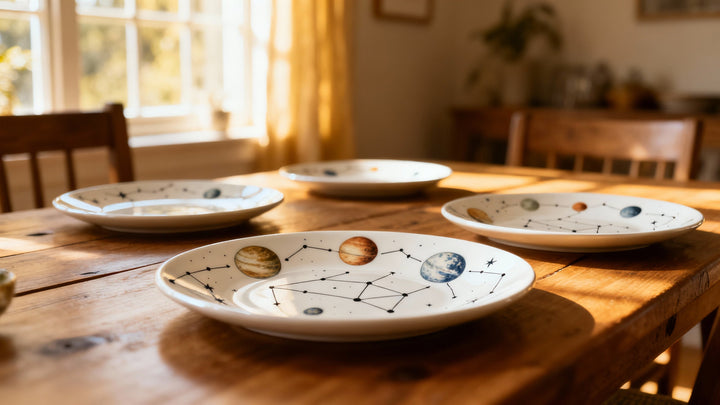
Then outer space arrived at the dinner table. Postwar fascination with rockets and the space race inspired “space age” designs. Designer George J. James created a now-iconic Starburst pattern with linear star motifs radiating across dishes, crystal, and even cutlery, visually aligning everyday tableware with the optimism and futurism of the era. When I lay out starburst pieces for a retro cocktail spread, they feel like tiny fireworks under the deviled eggs.
Materials and Manufacturing: Clay Competes with “Unbreakable” Plastics
The 1950s were not only about ceramic color. They were also the golden age of melamine tableware, a hardened plastic marketed as lightweight, colorful, and effectively unbreakable. Everyday tables often relied on melamine plates in solid pastel tones or nature-inspired motifs, especially in households with young children.
Ceramic manufacturers could not ignore that competition. Companies such as Gladding McBean in California, documented in an American Museum of Ceramic Art exhibition, shifted their focus from sewer pipes and roofing tiles toward colorful ceramic artware, embossed hand-painted dinnerware, and fine china. Through acquisitions of Tropico Pottery, the American Encaustic Tiling Company plants in Vernon and Hermosa Beach, and Catalina Pottery, Gladding McBean grew into the largest ceramic products manufacturer west of Chicago.
Their Franciscan dinnerware line became a staple from humble kitchens to the highest-profile dining rooms. Franciscan fine china patterns were chosen for Jacqueline Kennedy’s Air Force One service, Richard Nixon’s Presidential Yacht, Eleanor Roosevelt’s cottage, and Joseph Kennedy’s Florida home while also appearing in millions of California homes. Colorful embossed patterns like Apple and Ivy helped define an accessible yet aspirational vision of mid-century domestic life.
Meanwhile, Heath Ceramics took a different production path. After a one-woman show in 1944, a distribution deal in 1946 allowed Heath to move into a semi-industrial Sausalito factory using jigger wheels and slip casting. By 1949, the company was producing roughly 100,000 pieces a year. The Coupe line’s matte glazes and simple silhouettes, combined with later Rim Line forms designed for restaurant durability, proved that carefully considered color and shape could be mass-produced without losing their craft sensibility. Coverage in outlets such as Arts & Architecture, House Beautiful, and exhibitions at the Museum of Modern Art cemented Heathware as emblematic of California indoor–outdoor living.
In short, when plastics arrived boasting unbreakability and playful hues, ceramics fired back with color-soaked bodies, refined silhouettes, and a promise of tactile, natural warmth that plastic could not match.

How Color Changed Everyday Dining
If color had stayed in catalog photographs, it would be a footnote. Instead, it changed how ordinary meals looked and felt.
From “Best China” to Everyday Art
A feature on 1950s table settings framed the table as both functional and expressive. Formal settings still followed traditional etiquette, but casual tables were encouraged to be vibrant and personal. Durable colorful dishware, patterned or pastel linens, and coordinated palettes were presented as tools to make even Tuesday-night meatloaf feel festive.
Hosts were nudged to add friendly flourishes: place cards, napkin rings, simple flowers in vases that matched the color scheme. The advice was practical. Keep centerpieces low so guests could see one another. Plan the sequence logically—first the covering, then the dishes and glasses, then the centerpiece—and leave room for actual food.
Because melamine and brightly glazed ceramics were affordable and widely available, many households could reserve delicate inherited china for special occasions and use colorful everyday sets all week. The line between “company” dishes and breakfast dishes softened. Today, a Lawrence Journal-World column on collecting notes that younger homeowners are once again seeking ceramics that match 1950s and 1960s styles, including bright Czechoslovakian pottery, pastel California wares, and solid-color dinnerwares like Fiesta, precisely because they set such a joyful everyday tone.
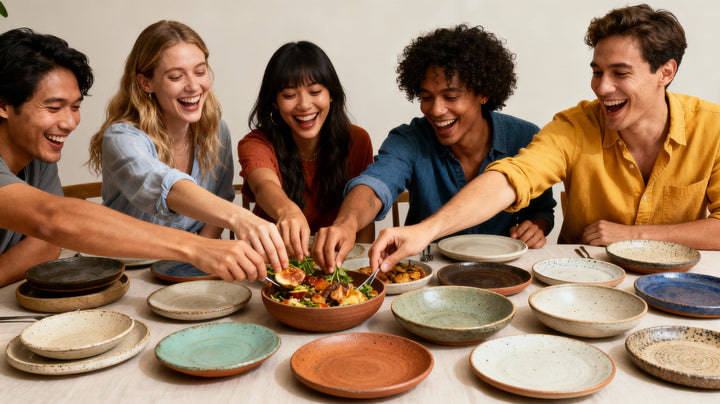
When I help a client unpack a box of “special” dishes that have lived in a cabinet since the 1960s and we put them into rotation for Sunday pancakes, you can see the emotional impact instantly. Colorful ceramics turn routine meals into mini-celebrations without adding a single extra recipe to the menu.
Color, Tactility, and Mindful Eating
Color is only one aspect of the sensory experience, but it works hand in hand with weight and texture. A mindful-eating guide from VanCassó, cited in a broader article on functional ceramic tableware, highlights research in the Journal of Environmental Psychology linking natural, tactile materials in kitchens to higher meal satisfaction and more mindful behavior than synthetic surfaces. Heavier plates, slightly textured glazes, and the gentle drag of a matte rim can subtly slow down eating and make portions feel more substantial.
Contemporary guidance from ceramic-focused brands suggests that smaller dinner plates around 8 to 9 inches and bowls of about 12 to 16 fluid ounces help typical servings look generous without encouraging overfilling. Strong contrast between food and plate color makes it easier to see how much you are eating. These recommendations mesh naturally with many mid-century designs. Turquoise or chartreuse plates frame pale foods, while classic blue-and-white scenes set off potatoes, grains, and creamy casseroles.
In my own styling work, swapping an oversized glossy white plate for a mid-century-scale colored plate often transforms both the aesthetics and the mood at the table. A standard serving of pasta looks abundant rather than skimpy, and the color story adds comfort or energy depending on whether we reach for muted sage stoneware or saturated Fiesta-inspired hues.
There are trade-offs. Dense, all-over patterns can sometimes hide whether a plate is fully clean. Very dark glazes may obscure small chips. On the upside, both can be more forgiving of cutlery marks and staining than high-gloss plain white porcelain, which shows every scuff. The 1950s color explosion gave hosts and designers more levers to pull in this balance between beauty, function, and long-term wear.

Pros and Cons of the 1950s Color Revolution
Colorful ceramics carry both delight and complexity. A quick way to see the impact is to compare key aspects side by side.
Aspect |
Upside of Bold Color |
Trade-offs and Risks |
Visual mood |
Instantly energizes or softens a room; makes everyday meals feel special; supports themed settings from autumn harvest to space age. |
Strong color can overpower food visually or clash with other decor if overused. |
Personal expression |
Lets hosts reflect personality through palettes, motifs, and mix-and-match sets; supports nostalgic or regional stories. |
Trend-driven colorways may fall out of fashion for decades, affecting resale and perceived “datedness.” |
Function and perception |
When paired with thoughtful plate sizes and high food–plate contrast, can support mindful eating and satisfying portions. |
Dense patterns can hide food residue; dark or very busy designs can make chips and cracks less obvious during inspection. |
Market access |
Mass-produced colored wares, including gas-station premiums and department-store lines, democratized stylish tableware. |
Mass production sometimes meant lower individual craftsmanship; certain glazes from earlier eras used materials now considered unsafe. |
Safety and care |
Modern vitrified lines such as HF Coors offer lead-free, cadmium-free, nonporous, dishwasher- and oven-safe colorful options. |
Some vintage orange, red, and yellow glazes, including early Fiesta reds and certain yellowware, involved lead or uranium compounds; many antique and mid-century pieces require gentler care and selective use. |
Understanding these pros and cons is crucial if you want to enjoy the joy factor of color without sacrificing safety or practicality.
Collecting and Using 1950s Color Today
The fascinating thing about color trends is how they cycle. Pieces that felt dated or even ugly in one generation suddenly feel fresh in the next.
A Lawrence Journal-World column traces how 18th-century English porcelain dominated collectors’ tastes in the 1950s, followed by handcrafted-looking Wedgwood and American art pottery in the 1970s, and then a boom in art pottery like Roseville in the 1990s. Today, the article notes, young homeowners are reaching back toward 1950s and 1960s styles, hunting for Czechoslovakian pottery in bright colors, California pottery with pastel glazes, and solid-color dinnerwares such as Fiesta.
The authors’ best practical advice still holds. If you want bargains, look for pieces that are currently out of style, because demand (and prices) tend to rise again when tastes shift. As a stylist, I routinely see this dynamic. Grueby vases, for example, were out of favor from the 1920s through the 1970s, yet the same article notes that today a Grueby vase can sell for about $7,500. That is the long game of color and form in the antiques world.
How to Choose Pieces That Work on a Modern Table
When you are building a 1950s-inspired colorful table, start by thinking like a designer, not like a museum curator.
I like to begin with a “backbone” of practical, durable pieces that can handle daily use, then layer in more delicate or characterful items. Sturdy stoneware dinner plates or modern vitrified lines such as HF Coors work beautifully as foundations. HF Coors, for example, produces hand-painted, vitrified ceramic dinnerware that is lead-free, cadmium-free, nonporous, and safe for the oven, broiler, microwave, dishwasher, and freezer. Their pieces are also backed by a chipping guarantee under normal use. That kind of specification means you can set them down on the table without flinching.
On top of that backbone, add vintage color: a 1950s starburst bread plate, a barnyard-themed cereal bowl, or a stack of mid-century pastel salad plates. For pure nostalgia, Fiesta is hard to beat. Just remember that not all Fiesta is created equal. The vintage line introduced in 1936 used natural uranium in its red and ivory glazes, and later red glazes after 1959 used depleted uranium. The Fiesta line reintroduced in 1986, often called Post-86 Fiesta, uses clay bodies formulated without lead and glazes that do not contain uranium dioxide. Post-86 pieces are materially safer than earlier uranium- or lead-containing wares and are clearly tailored for modern microwaves and dishwashers.
If you are unsure whether a colorful plate is vintage or later, clues from Fiesta collectors help. Post-86 items typically have a “dry foot” (an unglazed base ring) on plates and flatware pieces. Many vintage pieces, by contrast, have fully glazed or “wet” feet. Post-86 marks can also include impressed letters, a combined “H” symbol, or wording like “Lead Free” or “Microwave Safe.” Because both eras use a lowercase “f” logo, you cannot rely on that alone.
Once you know what is safe for direct food use, you can assign roles. Modern lead-free wares and clearly labeled Post-86 pieces can be your everyday workhorses. Older or uncertain items, especially those with orange or red glazes or with crazing and chips, can shine as underplates, platters for wrapped foods, fruit bowls, or purely decorative accents.
Safety and Care Basics for Colorful Vintage Ceramics
Safety is where the playful part of tabletop design must be balanced with a pragmatic eye.
Guides compiled from brands such as Malacasa, VanCassó, XH Ceramics, and museum sources like the Museum of Royal Worcester emphasize a few consistent points.
First, glazes matter. Modern manufacturers who publish material details and testing data, like HF Coors, stress that their products are lead-free and cadmium-free and use food-safe nonporous glazes. For older wares, especially those with bright orange, red, or certain yellow tones, Malacasa’s cottagecore guide recommends caution. Since lead-based paint was banned in the United States in 1978, post-1978 wares are generally a safer bet, but testing is still advised if you have any doubts. Items that test positive for lead or whose safety remains unclear can be repurposed as decorative trays or flower holders rather than used directly for food.
Second, understand where the decoration sits. Astialiisa’s care guidance and museum conservators distinguish between underglaze and overglaze decoration. If the surface feels completely smooth and uniformly glossy, decoration is likely under the glaze, making it more tolerant of gentle dishwasher cycles with mild detergent. If you can feel raised edges or see a different sheen, the decoration is overglaze. Metallic bands, hand-painted trims, and early transfer decals fall into this category and should always be handwashed with mild soap and a soft cloth.
Third, handle damage with respect. The Museum of Royal Worcester notes that cracks, chips, and crazing expose the porous ceramic body, allowing water and dirt to penetrate and destabilize repairs. Immersing cracked or crazed pieces in water, running them through the dishwasher, or attacking them with bleach can cause permanent staining or further losses. Antique care guides from institutions such as The Henry Ford and Antique Trader echo this, recommending that fragile or low-fired ceramics be cleaned only by professionals and that even stable pieces be washed gently with diluted detergent rather than harsh cleaners.
In practical terms, this means handwashing vintage and antique ceramics in warm, not scalding, water with a mild, non-citrus detergent and a soft cloth. Modern sources like Laloueme and Madame de la Maison emphasize drying pieces immediately with a lint-free towel, avoiding dishwashers altogether for vintage items, especially those with metallic trim, and spacing dishes in storage with napkins or felt between them to prevent scratches. Avoid sudden temperature swings—no fridge-to-hot-oven leaps and no plunging hot plates into cold water—to reduce the risk of thermal shock.
Finally, if you collect matte-glazed art pottery from the early 20th century, cleaning becomes even more delicate. Just Art Pottery’s cleaning guide, based on extensive experimentation, describes methods such as long soaks in water and ammonia for grime, vinegar for mineral deposits, and careful use of hydrogen peroxide for darkened crazing, always with strong cautions that what works on one piece may damage another. That level of intervention is best reserved for committed collectors who accept the risks or who work with professional conservators.
Styling Ideas: Bringing the Color Explosion to Today’s Table
Once safety and care are under control, the fun part is weaving 1950s color into your everyday rituals.
I often build tables around one color story at a time. A mint-and-red brunch, for example, might pair mint plates with a red-printed tablecloth, echoing the pastel-plus-accent logic of 1950s kitchens. A turquoise-and-black “diner” dinner might use turquoise dinner plates, black flatware, and a checker napkin pattern that nods to classic vinyl floors. For an autumn gathering, I love patterns inspired by Jewel Tea Autumn Leaf and other warm-toned mid-century motifs, with cream backgrounds and orange and brown leaves that make roasts and pies look extra abundant.
It helps to mix textures as much as colors. A matte sage stoneware dinner plate layered under a glossy, fruit-patterned dessert plate pulls together cottagecore coziness and mid-century charm. Hobnail glass tumblers or cut-crystal jugs, recommended by traditionalist essays from Trove Object Gallery, catch the light and offer grip-boosting texture while harmonizing with colored glazes nearby. Vintage or vintage-inspired butter bells with blue-and-white motifs add a tiny historic flourish while keeping butter spreadable on the counter using a simple water seal.
Color works best when it feels intentional, not random. Even if your collection is an eclectic mix of utilities, pick one or two hues to repeat around the table in linens, flowers, and accessories and let everything else play supporting roles in neutrals like white, wood, or stainless steel. That way the most saturated plates read as joyful focal points rather than visual noise.
Color Curious? Quick Answers
Are brightly colored 1950s dishes safe to eat from?
Some are, some are not, and the difference comes down to glaze composition, condition, and when they were made. Modern ceramic brands like HF Coors and contemporary lines highlighted by Malacasa and VanCassó explicitly advertise lead-free, cadmium-free, food-safe glazes and vitrified, nonporous bodies. Those are good candidates for daily use, especially when labeled microwave- and dishwasher-safe.
For older wares, especially bright oranges, reds, and some yellowware, caution is warranted because lead-based glazes were historically common and early Fiesta reds and ivory used uranium compounds. Collectors of Fiesta, for example, draw a clear safety distinction between vintage uranium- or lead-containing glazes and Post-86 Fiesta, which uses clay bodies without lead and glazes without uranium dioxide. If you are unsure, follow Malacasa’s advice: have pieces tested where possible and, when in doubt, repurpose them as decorative elements or for low-risk uses such as holding wrapped foods rather than direct contact with acidic or hot dishes.
How can I tell if my colorful Fiesta plate is vintage or Post-86?
Logo alone is not enough, because both vintage and Post-86 Fiesta use a lowercase “f” mark. Instead, look for structural and wording clues described in collector notes. Most Post-86 pieces have a “dry foot,” an unglazed base ring, especially on plates and flatware shapes, whereas many vintage pieces have fully glazed or “wet” feet. Post-86 items may also carry impressed marks such as a small “H,” pairs of letters, or words like “Lead Free” or “Microwave Safe,” all of which signal newer production and safer clay and glaze formulations.
If you are still unsure, treat the piece as a decorative accent or use it under a clear liner or white plate so you can enjoy the color without relying on it for direct food contact.
What if I love color but worry about it fighting with my food?
You do not have to choose between Instagram-worthy plating and a soothing, appetizing table. The mindful-eating research summarized by VanCassó suggests that smaller plates and strong contrast between food and plate help portions look generous and easy to read. In practice, that means pairing pale foods with darker or more saturated plates and darker foods with lighter backgrounds.
If you are concerned about color overwhelming the meal, start with colored rims rather than full-color bodies. A white plate with a turquoise or chartreuse band captures mid-century flair while leaving a neutral center for food. Another strategy is to use colorful salad or dessert plates layered on top of calmer dinner plates so color comes in smaller doses. The 1950s color explosion gave us tools; you get to decide how loudly they speak.

A Joyful Closing Note
Colorful mid-century ceramics are proof that everyday objects can carry enormous emotional weight. They were born from deep technical expertise, mass-production ingenuity, and a cultural craving for optimism, and they still have the power to turn scrambled eggs into an occasion. If you treat them with a conservator’s respect and a host’s playful heart, those turquoise, chartreuse, and starburst-splashed plates will keep serving up joy for decades to come.
References
- https://aic-color.org/resources/Documents/jaic_v8_06.pdf
- https://www.amoca.org/past-exhibitions/color-counts-gladding-mcbean-california-commercial-pottery-1930-1950/
- https://www.pbssocal.org/shows/artbound/visual-timeline-the-making-of-a-classic-california-company-heath-ceramics
- https://ceramics.org/about/what-are-ceramics/a-brief-history-of-ceramics-and-glass/
- https://www.museumofroyalworcester.org/discover-learn/china-care/care-of-ceramics/
- https://www.thehenryford.org/collections-and-research/digital-collections/artifact/291188/
- https://www.28ceramics.com/aiwz-fine-bone-china-teacup-and-saucer-sets-dinnerware-patterns-of-the-1950s-with-pictures-ehow.html
- https://www.apartmenttherapy.com/color-by-decade-the-1950s-color-therapy-196896
- https://www.thesprucecrafts.com/mid-century-dishware-guide-4126678
- https://justartpottery.com/pages/care-and-cleaning-of-art-pottery?srsltid=AfmBOoqv-QoZhnKhOGw82FaX5toPwBQXzkGBD4z8WKj7FBrs0lCAj31J