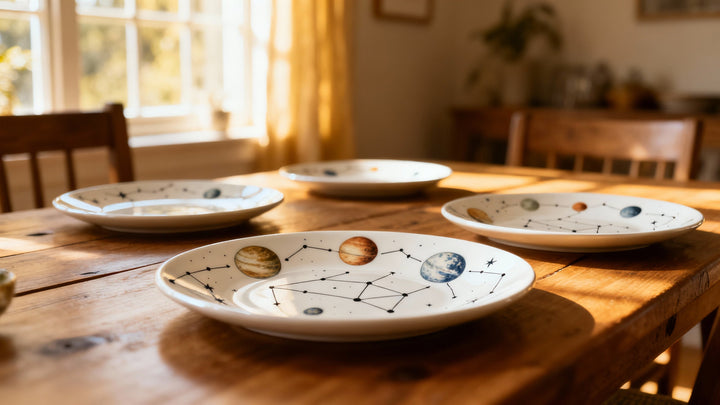


Ceramic dishes have a special kind of magic. They are cool and smooth in the hand, carry color and illustration like a tiny painting, and make the soft chime of clay meeting cutlery that no plastic bowl can quite imitate. For children, the right plate is not just a place to park peas; it is a daily art object that can quietly shape their sense of beauty, care, and even safety at the table.
At the same time, any parent who has watched a plate fly off a highchair knows that “beautiful” means nothing if a dish is unsafe, full of heavy metals, or too fragile for small hands. Ceramic safety experts, pediatric-focused dinnerware guides, and university environmental health teams are remarkably aligned on one message: children are more vulnerable to chemicals, microplastics, and dust than adults, so the surfaces that touch their food deserve serious thought.
This article weaves those safety insights together with design and family life, so you can choose kid-friendly ceramics that meet modern health standards and then turn them into everyday art lessons at your table.
Safety First: Building Trust in Ceramic Tableware
Why Kids Need Safer Surfaces
Several modern investigations into kids’ dinnerware point out that children are uniquely vulnerable to chemicals and microplastics that migrate from food-contact materials. One 2024 study summarized in a non-toxic kids’ dinnerware guide reports that infants may carry roughly 10 to 20 times more microplastic particles than adults. Tiny plastic fragments shed from bottles, plates, and utensils have been detected in placenta, breast milk, and infant stool. Early-life exposure can influence brain development, hormone systems, immune function, reproduction, and behavior.
Plastic dinnerware, even when labeled “BPA-free,” can still contain other bisphenols or phthalates that move into food, especially when heated. Several safety-focused parenting sources advise avoiding heating food directly in plastic and replacing scratched or cloudy plastic dishes, because damage makes leaching more likely. Some so-called bamboo or plant-based plates are in fact “bamboo composites,” where bamboo powder is bound with melamine-formaldehyde resin. Guides on eco-friendly dinnerware warn that these composites can include up to about half conventional plastic and may release formaldehyde when exposed to heat, so only melamine-free, binder-free products really qualify as non-toxic.
Ceramics and porcelain step into this picture as materials that, when properly formulated and fired, do not need plasticizers, phthalates, or melamine. Safety briefs on non-toxic dinnerware describe certified lead- and cadmium-free ceramic and porcelain as among the safer options for older children who can reliably handle breakable dishes. But that safety depends entirely on the glaze chemistry, firing, and condition of the surface. That is where specialized ceramic safety guidance becomes essential.
Decoding Ceramic Safety Language
Ceramic Materials Workshop and other technical educators emphasize that the words stamped on labels can be surprisingly confusing for parents. Fortunately, once you decode them, decisions get much easier.
Label or term |
What it actually means for families |
A glaze or finished surface has passed standardized leach tests for lead and cadmium at levels set by U.S. regulators, often using methods such as ASTM C738. Ceramic safety educators note that the familiar wine glass and fork symbol signals compliance with FDA guidance on lead and cadmium release when the product is used as directed. It does not promise scratch resistance, chip resistance, or durability in the dishwasher. |
|
A step beyond “food safe.” The glaze is not only low-leaching for heavy metals, but also smooth, durable, and free from defects such as crazing (fine crack networks) and pits where bacteria or contaminants can lodge. Ceramic Materials Workshop stresses that dinnerware-safe status must be confirmed on the specific clay body and firing schedule, because thermal expansion mismatch between glaze and clay can cause crazing. The FDA Food Code requires food-contact surfaces to be safe, corrosion-resistant, nonabsorbent, and resistant to pitting, chipping, crazing, scratching, scoring, distortion, and decomposition. |
|
Non-toxic (on art materials) |
A labeling term governed by standards such as ASTM C-1023 and ASTM D-4236 for ceramic and art materials. “Non-toxic” and similar claims primarily describe the hazards of handling the liquid or powdered material under typical use, not eating from the fired surface. Ceramic safety educators point out that these standards focus on labeling, not full toxicity testing, and do not automatically guarantee food-contact safety. |
AP seal |
An “Approved Product” seal used for art materials. A medical expert has reviewed the product and found no ingredients in amounts expected to cause acute or chronic harm, even to children, under typical art use. It is essentially a “safe for all ages” symbol for handling as an art supply, but it is not a dinnerware-safety certification. |
CL seal |
“Cautionary Labeling” seal. The product has been medically reviewed and properly labeled, but it is not considered safe for children under about 12 years old. Extra care is recommended; again, this is about handling and exposure, not automatically about eating off the fired ware. |
Ceramic safety educators warn that it is easy to misread “non-toxic” or an AP seal as “this is safe to eat from,” which is not necessarily true. For any plate, mug, or bowl your child will use for food, you want clear confirmation that the finished surface is dinnerware safe, not simply that the raw glaze is non-toxic to brush onto a pot.
When Ceramics Are Not the Right Choice
Even within ceramics, some pieces are not appropriate for kids’ meals at all.
Emerson Creek Pottery’s guidance on food-safe ceramics highlights several higher-risk categories: older or antique pieces, especially those made before the 1970s; bright yellow, red, or orange glazes from unknown manufacturers; and handmade imports from regions where lead glazes may still be common. Lead-glazed foodware can leach lead into meals if firing was incomplete, the glaze formulation is poor, or other metals, such as copper, were added in ways that make lead more soluble. Acidic drinks and foods such as tomato juice, citrus, sodas, tea, and coffee increase that leaching risk. The FDA requires clear warning labels on products that are not safe for food or drink, but older or unbranded pieces may lack this transparency.
University environmental health teams, such as the Office of Environmental Health and Safety at Princeton University, underline another layer of concern: poorly formulated or fired glazes can leach not only lead but also other metals and can develop crazing, chips, or pits. Crazing creates a web of fine cracks that compromises cleanability and can hold contaminants. Once a ceramic piece is chipped, cracked, or deeply scratched, especially on food-contact surfaces, child-focused ceramic safety briefs recommend retiring it from everyday use with kids. Damaged glaze or exposed ceramic body is harder to clean and may expose less stable layers beneath.
The takeaway is not that ceramic is dangerous by default. It is that only well-made, well-tested, and intact ceramic dishes deserve a place at your child’s table. That trust is what lets you then lean into color, pattern, and ritual without a nagging worry in the back of your mind.

Choosing Kid-Friendly Ceramic Pieces That Still Feel Like Art
Ceramics in the Mix with Steel, Silicone, and Bamboo
Parents rarely buy ceramic in a vacuum. The kid table today is a colorful lineup of stainless steel bento trays, suctioned silicone plates, bamboo bowls, and the occasional mystery plastic from a restaurant kids’ meal. Non-toxic dinnerware guides compare these materials in terms of safety, durability, eco-friendliness, and convenience.
Material |
What children experience |
Health and safety notes |
Watch-outs for families |
Cool, smooth surfaces with rich colors, patterns, or character illustrations. Some ceramic dishes, as one children’s tableware guide notes, are stronger than porcelain and hold warmth longer, which keeps food cozy. |
Expert safety briefs describe certified lead- and cadmium-free, high-fired stoneware or porcelain with dinnerware-safe glazes as non-porous, durable, and suitable for older children or kids who reliably handle breakable dishes. They are free of BPA, phthalates, melamine, and similar plastic chemicals. |
Fragility is the main tradeoff. Drops can chip or shatter pieces, and heavy dishes can be unwieldy for toddlers. Any chipped, crazed, or scratched surface should be retired from kids’ use. |
|
Shiny, metallic, sometimes rainbow-colored plates and bowls that feel solid but not too heavy. Guides on kid-friendly tableware note that stainless steel plates and divided trays can last from toddlerhood through elementary school. |
Several non-toxic dinnerware overviews call stainless steel the “gold standard” for children’s dishes: non-porous, resistant to bacteria, odors, and stains, and free from BPA, PVC, phthalates, melamine, and lead. A summary of pediatric guidance notes that the American Academy of Pediatrics has strengthened its recommendation of stainless steel over plastic for kids’ food containers. |
Stainless is not microwave-safe, and the feel or sound may not appeal to every child. It carries a higher upfront cost, though long service life balances that for many families. |
|
Food-grade silicone |
Soft, bendy bowls and plates, often with strong suction bases and cheerful colors. Many toddlers love being able to grab the rim without it feeling cold or fragile. |
Guides describe silicone as flexible, unbreakable, generally free from BPA, phthalates, lead, and PVC, and heat-resistant to roughly 400 to 425°F, depending on the product. It can go into microwaves and dishwashers and is excellent for reducing spills in the early self-feeding phase. |
Long-term health and environmental data are still developing. Some reviews note that silicone production is energy-intensive, that it can form microparticles under stress, and that end-of-life recycling options are limited. Several experts suggest treating silicone as a practical middle ground or supporting player rather than the only material in your kitchen. |
Bamboo and plant-based fibers |
Lightweight, often matte surfaces with earthy or pastel tones. Some brands offer compartment plates that visually organize meals. |
When truly plastic-free and melamine-free, plant-based dinnerware can be biodegradable and eco-friendly, using fibers such as bamboo, rice husk, or wheat straw. Guides on kids’ eco-dinnerware describe bamboo as naturally antibacterial and suitable for food contact. |
Many bamboo composites actually contain significant melamine resin. Safety investigations warn that these can release formaldehyde when heated. Hand washing is usually recommended, and parents are urged to look for clear “melamine-free” or “no plastic binders” labeling. |
Plastic |
Ubiquitous cartoon plates and bowls that are inexpensive and hard to break. Children often recognize characters instantly. |
Even plastics labeled “BPA-free” may contain other bisphenols or phthalates. Non-toxic dinnerware guides and parenting dietitians warn that these chemicals can migrate into warm or fatty foods and are linked with endocrine disruption and developmental concerns in children. Plastic dishes can also shed microplastics that children ingest. |
Multiple sources recommend never heating food directly in plastic, avoiding dishwashers for plastic pieces when possible, and replacing scratched or cloudy plastics. Plastic tableware also contributes to long-lived waste, which eco-focused brands flag as a concern for children’s future environment. |
In this landscape, ceramics become less a competitor and more the “grown-up” material your child gradually grows into. Stainless steel and silicone handle the hearty toddler years; ceramics and porcelain step in as the family’s everyday art pieces once your child has more control and understands that dishes stay on the table.
What Changes With Age
Dinnerware guides that follow children from babyhood through preschool highlight a few consistent age shifts.
During roughly 6 to 12 months, when babies begin solids, most of the action happens on the highchair tray. Feeding specialists and child-focused brands recommend soft-tip silicone spoons and suction-based bowls made from food-grade silicone or similar unbreakable materials. The goal is protecting gums, limiting mess, and letting babies experiment safely. Ceramic plates can still appear at the table at this stage—mainly in adult hands—so that babies see beautiful, stable dishes as part of the family scene even before they touch them.
From about 1 to 3 years, children lean into self-feeding. Several sources suggest that suction bowls and plates, deep walls, and stable designs reduce flipping and sliding while kids are still learning that dishes do not fly. Some brands specifically design ceramic kids’ plates with silicone bases or wraparound silicone rings that double as lids. In base mode, the silicone grips the table and helps small hands hold the dish; flipped, it becomes a lid for storing leftovers directly in the plate. When ceramics are used this early, non-toxic glazes, rounded edges, and stable, wide bases are especially important, and close supervision is non-negotiable.
As children move into roughly 3 to 5 years, dietitian-moms and parenting guides note that kids are more interested in using “real” plates, bowls, and cups, and in eating a wider variety of foods. At this stage, undivided plates are often recommended as the default, because divided plates can accidentally train kids to insist that foods never touch. Divided designs still have a place for extremely picky eaters or for visually cueing balanced meals, but they are best treated as a temporary tool rather than the permanent norm.
This is also the moment when ceramic and porcelain can shine. Non-toxic dinnerware guides describe ceramic, porcelain, and glass as affordable, safe options for older children or those who can reliably handle breakable dishes. Child-sized ceramic plates with rounded rims and playful illustrations, such as baby animals, can make kids feel included in the “real” table while keeping proportions and weight manageable. Matching kid-sized cutlery and cups gently signal that eating from ceramic is a privilege that comes with responsibility.
Turning Every Meal Into a Mini Art Class
Once trust and age-appropriate choices are in place, ceramic tableware can become a daily art lesson without a single lecture.
Color, Pattern, and Story
Kids’ dinnerware brands that use ceramics, bamboo, and steel are unanimous about one thing: color and illustration matter. Articles on children’s dishes note that bright, warm colors can improve appetite, and that plates decorated with animals, fairy-tale figures, or cartoon characters often tempt picky eaters to the table. Some guides even suggest that yellow or red dishes can be helpful for children who seem uninterested in food.
Ceramic really excels here, because glazes and decals can carry subtle shading, fine lines, and a depth of color that feels more like a storybook than a sticker. A child’s plate might feature fox cubs and fawns, bunnies or owls, or other baby animals playing among leaves. One children’s collection is described as using playful baby animal illustrations and a calm palette of white and pale green, combining cheerfulness with a soothing feel so the table is engaging but not overstimulating.
To turn this into art appreciation, you do not need a script. You might simply pause once a day to ask, “Who is on your plate tonight?” or “What color is the fox’s tail?” or “If this bowl were a forest, where would your broccoli trees grow?” These micro-conversations help children notice illustration, color, and composition in the same easy, playful way they learn words and shapes.
Texture, Temperature, and Sound
Ceramic adds sensory layers that plastic simply cannot deliver. Guides comparing kids’ materials point out that ceramic dishes tend to be heavier and hold warmth longer than some alternatives. You can invite your child to notice how their ceramic bowl feels warm under their fingers when it holds soup, then cools back to room temperature. You can name surfaces—glossy, matte, speckled—so glaze finishes become part of their vocabulary, not background noise.
The soundscape matters too. Stainless steel and silicone are often nearly silent; ceramic introduces a gentle clink when a spoon meets the rim. That small sound can become a cue for care: “Can you make your spoon sing softly instead of banging loudly?” In a household that prioritizes calmer mealtimes, learning to handle ceramic quietly is both a sensory game and a lesson in respect for objects.
Over time, these sensory details teach children that an everyday plate can be just as expressive and worthy of attention as the art they see in books or on walls.

Inviting Children Into Ceramic Making—Safely
While many families are content to stop at using ceramic tableware, some children will inevitably ask the irresistible question: “Can I make my own plate?” The answer can be yes, with guardrails.
Clay, Creativity, and Sensory Joy
A guide to non-toxic clay for kids notes that clay play supports creativity, fine motor skills, and sensory development for children roughly ages 3 to 14. Squishing, rolling, and forming clay builds hand strength and coordination in ways that feel like pure play. The key is choosing the right kind of clay and managing its dust.
Mineral-based and terracotta clays can generate fine dust containing silica when they dry out, are sanded, or are swept. The Office of Environmental Health and Safety at Princeton University documents that chronic inhalation of free silica can lead to silicosis, sometimes called “potter’s rot,” a serious lung disease. Clay bodies may also contain additives like talc, grog, perlite, or vermiculite; some talcs and vermiculites have historically been contaminated with asbestos. While careful modern sourcing can reduce this risk, safety recommendations strongly discourage sanding dry clay or reconditioning bone-dry scraps in ways that create dust.
For children’s projects, non-toxic clay guides suggest leaning toward air-dry or soft modeling clays that do not need high-heat firing and that expressly carry child-safety and toy labels such as “non-toxic,” “child-safe,” “CE certified,” or compliance with ASTM-F963. Products should have no harsh chemical smell, and the package should clearly state the intended age range, often three and up. Parents are advised to supervise younger children, keep clay away from mouths and eyes, encourage handwashing after play, and clean work surfaces with a damp cloth instead of sweeping powder into the air.
Glazes, Labels, and Why Adult Oversight Matters
Once clay enters the picture, glaze safety must come along with it. Ceramic Materials Workshop emphasizes that glazes are mixtures of silica, fluxes, and colorants, and that traditional low-fire techniques once relied on soluble lead compounds. Historical reports describe hundreds of lead poisoning cases among potters in the late nineteenth century. Today, modern glaze systems can be lead-free, and high-fire stoneware and porcelain techniques eliminate the need for lead as a flux. But that does not mean all glazes are benign.
Glaze safety notes describe various fluxes and colorants that are toxic by inhalation or ingestion, including lead, barium, lithium, and metal oxides of arsenic, cadmium, chromium (in its hexavalent form), nickel, and uranium. Some lustre or metallic glazes have contained mercury or arsenic and highly toxic solvents. Safety sheets emphasize that powdered glaze components, when weighed and mixed, can generate significant dust exposure, and that spray application dramatically increases inhalation risk.
For children, this context suggests a bright line: adults should handle dry glaze weighing, mixing, and kiln firing. If children participate in decorating, it should be with products that are clearly labeled for child use, carry appropriate non-toxic and toy safety labels, and ideally have AP seals indicating suitability for all ages as art materials. Even then, parents should remember that an AP seal is about handling safety, not dinnerware safety, so any piece that will touch food needs separate confirmation of food-safe and dinnerware-safe status from the manufacturer or studio.
Safety Data Sheets (SDS) are a helpful tool here. Members of ceramic glaze communities point out that SDS documents list a material’s ingredients, hazards, and handling precautions. When customers or parents are nervous about glaze safety, some studio potters prefer to share SDS and test results rather than offer only verbal reassurance. Clay suppliers such as Sheffield Pottery note that while their clays are certified non-toxic under ASTM D-4236, users are still responsible for ventilation, protective equipment, and testing finished ware for its intended use.
Kilns, Fumes, and Studio Rules
Kilns are an essential part of ceramic art and one of the clearest boundaries in a child-inclusive studio. Safety data from university and industry sources show why.
Electric and fuel-fired kilns operate at very high temperatures, from about 1,382°F for some raku and bisque firings up to around 2,642°F for certain porcelains. As clay and glaze materials heat, they release gases: carbon monoxide from burning organic matter, sulfur oxides from sulfur compounds, nitrogen oxides, and sometimes chlorine and fluorine from specific minerals or fluxes. At high temperatures, metals such as lead, antimony, cadmium, selenium, and precious metals can vaporize, adding metal fumes to the mix.
Health and safety documents describe these gases and fumes as highly toxic by inhalation in large amounts, capable of causing acute and chronic lung problems, carbon monoxide poisoning, and eye damage from infrared radiation. One report notes that when a kiln operates near 2,370°F, its outer surface can reach about 595°F, with air one foot away measuring around 156°F. These temperatures can cause burns and significantly raise room temperatures, sometimes above 100°F.
Adult potters are advised to use proper ventilation, avoid lead at stoneware temperatures, wear infrared-rated eye protection when viewing inside kilns, keep combustibles away, and verify that kilns shut off correctly. For households, these realities strongly suggest that children should not operate, open, or stand close to active kilns. The kiln becomes part of the story you tell about ceramic art rather than a piece of equipment kids touch.

Everyday Rituals That Grow Long-Term Appreciation
Once safety, age-appropriateness, and studio boundaries are in place, the real fun begins. Appreciation rarely arrives in one grand lesson; it accumulates through tiny, repeated moments.
You might invite your child to choose which animal plate they want at dinner, while you quietly reserve only those pieces you know are certified for food contact. You might let them help carry an unbreakable plate stack to the table and then place a special ceramic bowl down yourself, narrating, “This one is ceramic; we hold it with two hands.” When a favorite ceramic mug develops a crack, you can retire it together, explaining that damaged glaze is harder to clean and not safe for food anymore, and perhaps repurposing it as a pencil cup so the artwork lives on in a new form.
Non-toxic dinnerware guides emphasize that there is no single “right” material or design for all families. Mixing and matching stainless steel, silicone, plant-based fibers, and carefully chosen ceramic or porcelain pieces lets you balance safety, environmental values, budget, and aesthetics. Seen through a child’s eyes, that variety becomes a gallery of textures and colors that tell a story about how your household cares for both people and objects.

FAQ
Is ceramic tableware safe for everyday use with children?
Ceramic and porcelain can be safe for children when a few conditions are met. Safety guidance from non-toxic dinnerware experts recommends choosing products explicitly labeled as lead-free and cadmium-free, made with food-safe glazes that meet FDA limits for lead and cadmium leaching, and ideally described as dinnerware safe rather than just “decorative.” High-fired stoneware or porcelain with dense, vitrified bodies and smooth, defect-free glazes are preferred because they are less porous and more durable.
Safety educators also stress that no ceramic is absolutely “100 percent lead-free” in the geological sense, because trace heavy metals occur naturally in raw materials. The important point is that well-formulated and properly fired dinnerware keeps any potential release well below regulated limits in standardized tests. For children and other vulnerable groups such as pregnant women and nursing mothers, several sources recommend avoiding older, antique, or unknown ceramics and sticking with pieces whose safety is clearly documented.
How can I quickly screen a ceramic piece at home?
A home test cannot replace laboratory testing against FDA standards, but it can help you decide which pieces to use daily and which to treat as decorative. Guidance from ceramic safety and pottery brands suggests a simple sequence of questions. First, check the product labeling. Does it say “food safe” or specifically “not for food use”? Are there clear statements about lead- and cadmium-free glazes and compliance with relevant food-contact standards? If a piece is marketed for children, look for reassurance that glazes are tested for dinnerware use, not just that paints are “non-toxic” to handle.
Second, inspect the surface closely under good light. Dinnerware safety experts warn against using ware with crazing (fine crackle patterns), chips, deep scratches, or pits on food-contact surfaces, because these defects can harbor bacteria and may indicate glaze-clay mismatch or instability. Third, consider the origin and age. Older, brightly colored, or unbranded pieces of uncertain origin, especially reds, oranges, and yellows, are higher risk and better suited as decorative objects, plant saucers, or toy tea set props with no real food.
Some pottery companies mention that hardware-store lead test kits can provide a rough indication of contamination risk, particularly on suspect antique or imported ware, but they emphasize that only professional lab testing can confirm compliance with FDA leach limits. When in doubt for everyday children’s meals, err on the side of caution and choose pieces with documented safety.
Do I need to give up plastic kids’ dishes completely?
Non-toxic dinnerware guides are generally pragmatic rather than absolutist. They highlight the ways plastics can leach chemicals into food, especially when heated, and how microplastics shed from plastic items have been found in environments as intimate as placenta and infant stool. Because children are especially sensitive to endocrine-disrupting chemicals such as certain bisphenols and phthalates, many experts encourage parents to reduce reliance on plastic over time.
At the same time, they recognize that durable plastic pieces can be hard to replace overnight. A common strategy is to start by swapping the most frequently used and high-heat items, such as plates and bowls used daily for warm meals, for alternatives like stainless steel, ceramic, silicone, or truly plastic-free plant-based dinnerware. Several sources recommend never microwaving food in plastic, minimizing dishwashing heat exposure for plastics, and retiring any scratched, cloudy, or warped plastic dishes.
Seen through a child’s eyes, this gradual transition can be framed positively. You might explain that the new stainless steel lunch tray, ceramic dinner plate, or silicone suction bowl is “safer for your body and kinder to the planet,” and invite them to help choose colors or patterns. Over time, as ceramic and other materials take center stage, children learn both to appreciate the beauty of their dishes and to think critically about what those dishes are made from.
In the end, enhancing children’s appreciation for ceramic tableware art is not about a single perfect plate. It is about building a colorful, well-considered tabletop ecosystem where every dish earns its spot through safety, function, and joy—and where each meal becomes a tiny, tactile conversation between your child and the art they hold in their hands.

References
- https://ehs.princeton.edu/health-safety-the-campus-community/art-theater-safety/art-safety/ceramics
- https://www.southtexascollege.edu/academics/visual-arts/safety/ceramics.html
- https://community.ceramicartsdaily.org/topic/22551-clay-toxicity-for-children-do-i-need-a-toxicology-report/
- https://www.childishplates.com/?srsltid=AfmBOor4nd0EYsCs6ay_sYsmLBWmBPKLLtrkq128UtPWvOE-ZW3p3JZO
- https://www.ambowls.com/info/how-to-choose-ceramic-tableware-for-children-89545013.html
- https://www.anchenggy.com/blog/best-non-toxic-kids-dinnerware.html
- https://www.anzhucraft.com/non-toxic-dinnerware-for-kids/
- https://ashleyalexiscreative.com/non-toxic-dinnerware-that-kids-and-parents-will-love/
- https://www.babycutlery.com/how-to-choose-the-best-kids-dinnerware-from-baby-to-preschool/
- https://ceramicmaterialsworkshop.com/demystifying-ceramic-glaze-labels/