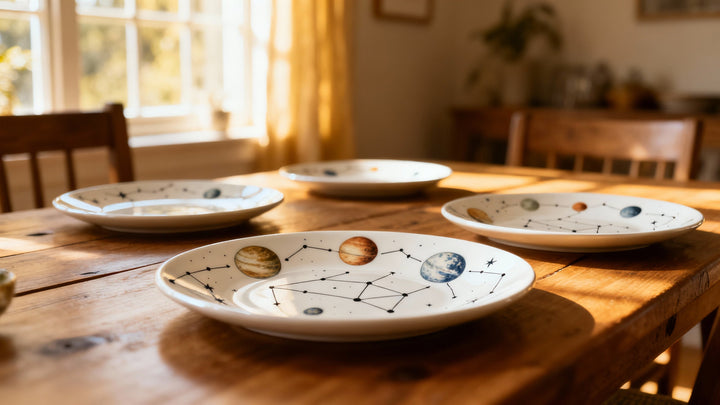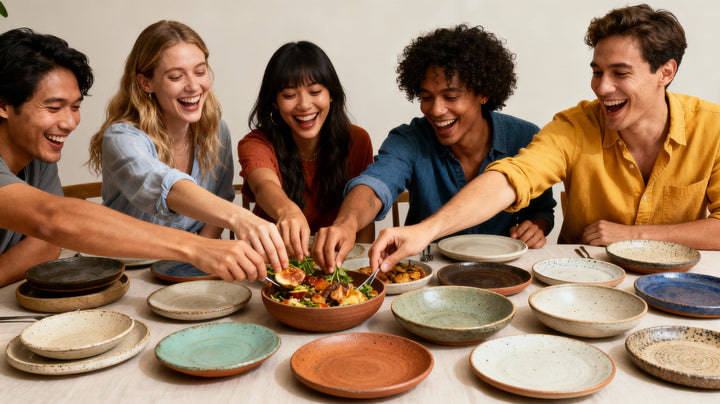


A Colorful Tabletop Editor’s Intro
I curate joyful, everyday dining objects that can take a fork’s scratch, a child’s reach, and the heat of a hearty home-cooked meal. That means living in the real world of clay dust, glaze chemistry, firing schedules, shipping boxes, and the long, long lives of fired pieces once they leave the kiln. So here’s a candid, artful, and practical look at a phrase that keeps popping up in tableware marketing: “biodegradable ceramics.” The words sound perfect together; the science and lifecycle realities tell a more complicated story. The paradox is this: we crave disposables that vanish and reusables that last, and fired ceramics are definitively the latter. Understanding that tension helps you buy smarter, care better, and support the makers moving the field toward genuinely lower-impact practices.

What “Biodegradable” Actually Means
Biodegradable is not a vibe; it is a precise process. According to research summarized by the National Institutes of Health library, biodegradation is the breakdown of materials by microorganisms into carbon dioxide, water, and biomass. It depends mostly on a material’s molecular structure rather than where it came from. It is also different from compostability, which requires engineered conditions such as controlled moisture, oxygen, and temperature, and different again from simple disintegration, which can create small fragments without true biological conversion. This distinction matters at the table: “biodegradable” is a promise about end-of-life behavior under specific conditions, not a synonym for “comes from nature.”
Are Ceramics Biodegradable?
Unfired clay is an earthy mixture that can be slaked down and reformed; fired ceramics are something else entirely. Once clay is vitrified into a ceramic body, it becomes an inorganic, non-metallic, hard, and chemically resistant material. Industry sources emphasize that fired ceramics are eco-friendly in many ways, but not compostable or biodegradable on human timescales. Field work in Ghana examining discarded ceramic artifacts observed that fired shards persist for centuries; they are inert enough to block drains and long-lived enough to raise end-of-life management challenges. The catch is that the greenest dinner plate is usually the plate that stays in use for decades without failing. That durability is the opposite of biodegradability, and it is also exactly why ceramics can be a sustainable choice when you prioritize long service life over planned obsolescence.
Why the Paradox Exists
Two things get conflated. First, “clay is biodegradable” can be literally true for the raw material, but fired tableware is not simply “clay” anymore. Second, “bio-based” or “waste-derived” inputs are not the same as “biodegradable” outputs. An eggshell-derived glaze replacing mined calcium is a bio-sourced innovation; it does not make the finished plate decay safely in your compost bin. Consumers also want simpler stories and cleaner tags at the point of sale, and biodegradable sounds better than “chemically inert for centuries but worth keeping.” Yet for food-contact ceramics, inertness is a safety advantage. The right question to ask is not “will it decompose?” but “how well is it made, how long will it last, and can its production and end-of-life be cleaner than today?”
The Ceramic Lifecycle, Without Sugarcoating
A plate’s footprint begins long before the first meal and lasts long after the last.
Mining, Glazes, and Chemistry
Ceramics rely on natural minerals such as clays, feldspar, and quartz, then add glaze components built on glass formers, stabilizers, and fluxes. Studio practice guides describe silica as the glass former, alumina to stiffen the melt, and fluxes to lower the melting point; opacifiers and colorants add looks and personality. This chemistry can be completely food-safe, but it requires responsible sourcing and rigorous testing. A study of Ghanaian dumpsites warns that glazes containing heavy metals like lead or cadmium can leach into soil and water, underscoring the need for lead-free and verified formulations in dinnerware. On the studio side, wet glaze sludge should never go down a sink; clay traps and settling systems keep particulates out of municipal pipes and waterways.
Firing Energy and Kiln Choices
Firing turns mud into marvels, but it takes energy. Modern kilns are far more efficient than historical coal or wood chambers, and some factories supplement with solar power. Artisanal and industrial practices vary widely. An Oregon anagama wood kiln reported burning about six cords of wood to transform around five hundred pieces in a firing cycle, a dramatic, communal process that is not representative of most tableware and that shows how energy inputs can spike for certain aesthetics. On the factory side, a case study in Brazil quantified monthly emissions for a porcelain tile line at about 70,711 kg CO2‑eq, roughly 155,890 lb, with grid electricity accounting for about three-quarters of the carbon. That same line reported an intensity of about 0.337 kg CO2‑eq per square meter of output, which works out to about 0.07 lb CO2‑eq per square foot.
Transportation Often Dominates
Shipping raw materials and finished goods adds a footprint that buyers rarely see. A Thai life‑cycle assessment of ceramic tiles found that raw material transportation was the single largest impact driver, with distances in the hundreds of miles. That same study reported global warming impacts around 3,730 kg CO2‑eq per metric ton of tile, which translates to approximately 3.73 lb CO2‑eq per pound of tile. Method choices and plant technologies matter a great deal: older US Environmental Protection Agency compilations showed averages closer to 300 kg CO2 per metric ton of tile, a difference that illustrates how results can vary by equipment, fuel, and geography.
Use-Phase Impacts Can Surprise You
Durable tableware tends to have low impacts while in use, especially compared with disposables. The biggest use-phase question is how you wash and dry. An artist-led assessment summarized by Ceramics Now estimated that a handmade stoneware mug carried about 16.5 lb of CO2 across its full life, with dishwashing and long-distance air shipping dominating the total. That perspective reframes responsible consumption: a well-made mug you wash in full dishwasher loads beats a stack of single-use cups every day of the week.
End-of-Life Is Not a Dead End
Ceramic shards do not vanish, but they can be valuable. Ground ceramic material is commonly reused as aggregate in geotechnical engineering and as a stabilizer for expansive soils, diverting waste from landfills. Research in green concrete shows that finely milled waste tile powders replacing about 5 to 20 percent of ordinary Portland cement can maintain or even improve compressive strength, a practical circular outlet for broken ware. Municipal realities still matter: about one-third of global waste is openly dumped, rising to higher rates in lower-income settings, which means real-world end-of-life pathways depend on local infrastructure.
Better Than Biodegradable: Proven Paths to Lower-Impact Ceramics
Innovation in ceramics is humming, and it is more about smarter inputs and longer service than about planned decay. Studio and industry sources converge on a few high-impact levers.
Local and reclaimed clays cut transport miles and conserve resources. Closed-loop studios reclaim trimmings and failed pieces, and many factories already recycle in-plant dusts and sludge back into bodies and glazes. Energy matters at every scale. Makers are optimizing kiln schedules, exploring single-firing where appropriate, and investing in more efficient kilns; some facilities power operations with renewables. Digital design and 3D printing reduce waste while opening new forms. Chemistry is getting cleaner too. Lead-free, food-safe glazes are standard for responsible dinnerware, and materials science is pushing fresh routes to the same performance with less mining.
One elegant example comes from Yale Engineering, where a ceramic artist working with a materials lab substituted eggshell waste as the calcium source in a glaze. Pin-on-disc wear tests showed similar abrasion resistance to mined calcium carbonate recipes, dishwasher cycling around eighty runs served up no measurable leaching, and aesthetic results improved. The key lesson is not that your plate becomes “biodegradable,” but that its ingredients can be sourced smarter without sacrificing durability.

A Quick Reality Table
Topic |
Common Claim |
What the Evidence Shows |
What To Ask For |
Biodegradability |
“Ceramics are biodegradable.” |
Fired ceramics are inert and persist for centuries; raw clay is not the finished product. Studies in Ghana document long-lived shards and potential heavy metal leaching from some glazes. |
Lead-free, tested glazes and durable bodies; plan for reuse, repair, and recycling pathways. |
Energy in firing |
“Modern kilns are efficient, so emissions are negligible.” |
Efficiency helps, but firing still drives emissions; one Brazilian line reported about 0.07 lb CO2‑eq per square foot and roughly 155,890 lb CO2‑eq per month. |
Evidence of efficient kilns, optimized schedules, and renewable electricity. |
Transport |
“Sourcing doesn’t matter much.” |
A Thai LCA found transport to be the biggest hotspot, with large impacts per pound of tile. |
Local clay, local production, or transparent sourcing and logistics. |
Waste to value |
“Broken ceramics are landfill only.” |
Ground ceramics stabilize soils and replace a portion of cement; waste tile powders around 5 to 20 percent often maintain or improve strength. |
Take‑back options, partnerships with concrete or road projects, and in‑house reclaim. |
Safer chemistry |
“Natural equals safe.” |
Safety comes from formulation and testing, not labels; lead-free, food-contact glazes are essential. Eggshell-derived calcium shows mined minerals can be substituted responsibly. |
Documentation of leach testing and food-contact safety; lead-free glazes as standard. |
Practical Buying Guide for the Colorful Tabletop
Start with what you can verify. For dinnerware, look for manufacturers or studios that state, in plain language, that their glazes are lead-free and intended for food contact, and that they have conducted leach testing. My studio tests begin with the fork-and-knife rub on sample tiles and continue through at-home cycles; many responsible producers do the same and will say so. Favor durable, vitrified bodies that are dishwasher safe, microwave safe, and oven capable within reasonable bounds; those signals track with long service life. Some US makers publish chip warranties and appliance safety across broiler, oven, dishwasher, and freezer, which is exactly the kind of practical reliability that avoids replacements.
Ask where the clay and minerals come from. Any answer that shows geographic proximity, reclaimed inputs, or a concrete plan to cut freight is a good sign. If the maker touts “biodegradable ceramics,” request a plain-English explanation of what that means for a fired plate; you will likely find they really mean responsibly sourced or recycled ingredients. On packaging, prefer recycled cardboard and reclaimed paper cushioning. If the piece must travel a long way, consolidate shipments and avoid air when you can.
Care and Use Tips That Shrink Your Footprint
Ceramics thrive on steady habits. Load the dishwasher full and select energy-saving modes; that single change showed up as one of the largest drivers in a cradle-to-grave mug estimate reported by Ceramics Now. Avoid sudden thermal shock by letting hot pieces cool a bit before rinsing and by preheating plates in a warm oven rather than blasting heat. Skip harsh scouring on glossy glazes; a non-scratch pad preserves finish and keeps plates attractive for years. If a rim chips, a professional repair can extend the life of a beloved piece. When a plate is truly at the end of its dining life, repurpose it as a plant saucer or donate it to mosaic artists. For bigger volumes, ask local contractors or public works if they accept clean ceramic rubble for aggregate or soil stabilization.
Data Snapshots to Ground Your Decisions
Measure |
Reported Figure |
Context and Source |
Production intensity |
About 0.07 lb CO2‑eq per sq ft |
Case study of a porcelain tile line where electricity accounted for about 76 percent of emissions; reported by Case Studies in the Environment. |
Monthly factory total |
Roughly 155,890 lb CO2‑eq |
Same Brazilian production line; monthly total. |
Transport hotspot |
Largest contributor in one LCA |
Thai study quantified transport as the top hotspot and estimated around 3.73 lb CO2‑eq per lb of tile using one method; published via the Ceramic Society of Japan. |
Older benchmark |
About 661 lb CO2 per metric ton |
US Environmental Protection Agency compilation for tiles; methods and plants differ widely. |
Mug life footprint |
About 16.5 lb CO2 |
Handmade stoneware mug estimate with shipping and dishwashing dominating; summarized by Ceramics Now. |
Waste tile powders |
Often optimal at 5 to 20 percent |
Review in MDPI Buildings shows partial cement replacement commonly maintains or improves strength. |
Waste management reality |
Around one-third of global waste openly dumped |
Rates rise further in lower-income settings; Ghana case study highlights end-of-life challenges; Springer Nature. |
Eggshell glaze durability |
No measurable leaching after about eighty dishwasher cycles |
Wear and leach tests conducted with support from Yale Engineering. |
How Makers Are Reducing Impact Without Greenwash
Sustainability leaders in ceramics are blending craft with systems thinking. Studio and brand reports describe using local clays, reclaiming every trimmings bin, and standardizing lead‑free, food-safe glazes. Some invest in efficient electric kilns and power them with solar. Others embrace single‑firing where the body and glaze are matured together, shaving a firing pass while maintaining performance. Digital modeling and 3D printing reduce wasted material. Innovative sourcing replaces mined minerals with byproducts such as waste glass or agricultural ashes that lower firing temperatures. The mission statements in this space are consistent: design for longevity, plan for take-backs, and make objects that earn their place on the table every day and for many years.
The Bottom-Line Guidance on “Biodegradable Ceramics”
If a ceramic plate actually biodegraded quickly, it would be a poor plate. For food-contact ware, chemical inertia and durability are virtues, not vices. That does not excuse sloppy sourcing or energy-wasteful firing; it clarifies what to optimize. The scenarios with the lowest footprints combine durable design, efficient processing, responsible chemistry, shorter transport, and smart use-phase habits. The strongest single move you can make is to choose pieces that you love using, that are safe, and that are made by people who publish their safety and sustainability practices. That plate will stay in circulation and keep you from buying three others to replace it.
FAQ
Are ceramics biodegradable at home like some compostable plastics?
No. Fired ceramics are chemically inert and persist for centuries. Biodegradable plastics depend on specific molecular structures and often need industrial composting conditions. Fired dinnerware should be designed for longevity, not decay.
Does wood firing make a plate more sustainable because wood is “natural”?
Not necessarily. Wood firing can be extremely energy intensive; one celebrated kiln has been reported to burn about six cords of wood in a single cycle for roughly five hundred pieces. That process is about a specific aesthetic and community practice, not about minimizing carbon.
How can glazes be both safe and eco‑forward?
Safety comes from formulation and testing. Lead‑free, food‑contact glazes are the baseline. Bio‑sourced inputs such as eggshell-derived calcium can replace mined minerals without sacrificing durability, as shown in testing supported by Yale Engineering, but the finished glaze remains an inert protective glass.
What should I ask a maker before buying dinnerware?
Ask if glazes are lead‑free and tested for food contact, whether the body is vitrified and dishwasher safe, and where the raw materials are sourced. If they tout “biodegradable ceramics,” ask them to explain the claim in terms of a fired plate’s actual end-of-life pathway.
Is recycled ceramic useful, or does it just go to landfill?
It is useful. Crushed, clean ceramics can be used as aggregate in geotechnical projects, and finely ground waste tile powders at modest replacement rates often maintain or improve concrete strength, creating practical circular outlets.
Does a handmade mug really have a bigger footprint than a factory mug?
It depends on firing efficiency, shipping, and how you wash. A reported artisan mug estimate around 16.5 lb CO2 shows that dishwashing choices and long‑distance shipping can dominate. Full dishwasher loads and regional buying shrink the difference fast.
Takeaway
Biodegradable sounds good, but for ceramics it is usually the wrong target. Fired dinnerware is not biodegradable on human timescales, and that is exactly why it excels at everyday, every‑year service with low use‑phase impacts. The sustainable move is to buy fewer, better pieces that are lead‑free, durable, and made with transparent practices; to support studios and factories that embrace reclaimed materials, efficient kilns, and local sourcing; and to use and wash your pieces mindfully. When an object brings color and joy to the table for decades and still finds value at end‑of‑life, you have resolved the paradox in the only way that truly matters: by choosing longevity with intention and beauty with evidence.
References
- https://www.academia.edu/57611192/Assessing_the_environmental_impact_of_ceramic_tile_production_in_Thailand
- https://ui.adsabs.harvard.edu/abs/2020JCPro.26621825S/abstract
- https://pmc.ncbi.nlm.nih.gov/articles/PMC12298952/
- https://sustainability.tufts.edu/wp-content/uploads/LifeCycleAnalysisPlasticPlatevsCeramic.pdf
- https://upcommons.upc.edu/bitstreams/17efdd09-0116-4579-831b-7955eb2557d4/download
- https://engineering.yale.edu/news-and-events/news/cracking-case-art-eggshells
- https://online.ucpress.edu/cse/article/doi/10.1525/cse.2025.2475286/213070/Material-and-Energy-Flows-in-Porcelain-Tile
- https://www.ceramicsnow.org/articles/how-yuliya-makliuk-tried-to-invent-the-worlds-most-sustainable-pottery-and-what-came-out-of-it/
- https://flutejournal.com/exploring-sodiceram-the-future-of-sustainable-ceramics/
- https://ggsceramic.com/news-item/ceramic-materials-and-pollution-explore-how-eco-friendly-are-they