

Walk into almost any kitchen cabinet and you can feel it: the soft floral cereal bowl that “belongs” to one person, the heavy matte-black plate that feels made for another. Those quiet pairings are often treated as pure personal taste, but beneath the glaze there is a story about gender, power, and habit that runs much deeper than color palettes.
As a Colorful Tabletop Creative & Pragmatic Joy Curator, I spend a lot of time test-driving dinnerware in real homes, restaurants, and studios. Over and over, I see the same pattern. Our plates, bowls, and mugs are not just carriers for food. They are tiny stages where gender stereotypes perform every day. The good news is that once you see those scripts, you can rewrite them into something far more joyful and inclusive.
How Gender Stereotypes Sneak Onto The Table
Before we talk bowls and glazes, we need two building blocks: taste and social norms.
A sustainability-focused piece on taste and social norms describes taste as an inner compass for what feels desirable, shaped by our experiences, background, and emotions. Social norms are the unwritten rules that tell us what is appropriate. These two overlap like circles in a Venn diagram. Our “private” tastes are formed inside social frameworks, and those frameworks reflect who has power in a culture.
Gender stereotypes are one of the strongest sets of norms in that framework. Studies of gender role attitudes in families show that beliefs about what women and men “should” do at home and at work form patterned attitudes: some families are uniformly traditional, some uniformly egalitarian, and others are mixed. Research in family psychology and occupational health consistently finds that traditional attitudes link women to unpaid domestic labor and caregiving, and men to paid work and public roles.
This plays out very clearly in household chores. In Spanish survey data analyzed in an occupational health psychology study, women spent almost twice as much time as men on unpaid work. The authors reported that women devoted about 38 hours a week to caring for children compared with 23 hours for men, 20 hours vs. 14 in caring for relatives, and 20 vs. 11 on chores such as cooking and cleaning. Time-diary studies of married couples in the United States, summarized in classic work on the “gender division of household labor,” find the same pattern: women’s housework hours fell over several decades, men’s hours roughly doubled from a low base, yet women still do around two-thirds of total housework in the 1990s.
Meanwhile, the global Cookpad–Gallup World Cooking Index defines a “cooking gender gap” as the difference in average weekly home-cooked meals between women and men. In 2022 women cooked 8.7 meals per week compared with 4.0 for men, leaving a gap of 4.7 meals. Men’s cooking frequency actually fell from the previous year, while women’s remained stable.
When you connect these dots, you get a simple but powerful insight. The person our culture expects to cook, set the table, and wash the dishes is still most often a woman, even in dual-earner households. That expectation quietly shapes who chooses ceramic dinnerware, how it is designed, and who the “ideal customer” is imagined to be.
Taste is not a neutral, isolated preference; it is a socially taught response. Gender stereotypes are woven into that process so deeply that a bowl can feel “wrong” in your hand simply because it violates a norm you never consciously chose.

A Short History Of Gendered Tableware
Gendered dinnerware is not a quirky modern marketing trick. It has a long, very intentional history.
Japan’s Meoto Bowls And First Meals
In Japan, tableware has historically reflected gendered social roles in deliberate, ritualized ways. A cultural overview of Japanese tableware traditions describes how clear gender differentiation emerged during the Edo period, when improved craftsmanship allowed makers to scale shapes and sizes to different bodies and roles.
Men were associated with physical strength and larger appetites, so their rice bowls and teacups were built bigger and sturdier. Women’s pieces were smaller, lighter, and more delicately decorated to emphasize refinement and modesty. Meoto jawan, or “husband and wife bowls,” are a perfect example: paired rice bowls where the husband’s is noticeably larger, often more than a third bigger, while the wife’s is petite and refined. The set itself symbolizes unity, yet the size difference literally encodes a hierarchy of needs.
The gender coding starts very early. In the okuizome “first meal” ceremony around 100 days after birth, boys and girls traditionally receive different lacquerware sets. Boys’ dishes are often vermilion with bold motifs like irises or sun rings, signaling competitiveness and strength. Girls’ sets tend to have a black exterior with vermilion interior, decorated with delicate floral motifs. Those choices are not just cute; they whisper scripts about how boys and girls should be in the world.
Even chopsticks carry gendered expectations. A common guideline has been about 9 in for men and 8 in for women, based on hand size. Today, many households simply choose what feels comfortable, yet the older rules reflect a period when tableware acted as a constant lesson in gender.
Interestingly, contemporary Japan is seeing those distinctions flatten. Younger generations, especially in urban settings, are choosing tableware based on comfort, aesthetics, and practicality rather than rigid gender rules. Still, the templates are there, ready to be reused in subtle ways.
Victorian Dining Rooms As Masculine Stages
Across the world and a century earlier, late nineteenth-century middle-class dining rooms in settler New Zealand were ideologically framed as masculine spaces. Archaeological and historical research into Victorian homes describes the dining room as a stage for the man’s respectability and role as provider. Architecture and decor were tailored to public display: slightly more decorative fireplaces, strategic placement near the kitchen to manage the flow of servants and dishes, and special cabinets to show off the “best” wares.
Matching dinner sets were a core part of this theater. An American study cited in that work suggests a basic middle-class dinner set involved an impressive roster of specialized forms: dinner plates, soup plates, small plates, muffin plates, sauce and soup tureens, platters, covered and open serving dishes, a butter dish, a pitcher, a gravy boat, and more. These sets were often duplicated in separate “public” and “family” versions.
Matching sets signaled order, control, and gentility. They also marked who controlled resources. The acquisition and display of these ceramic armies were tied to the masculine project of status, even though women did the bulk of the work using them.
If you have ever inherited “the good china” that you are slightly scared to use, you have met the descendant of that Victorian impulse.

When Plates Themselves Signal Gender
You might be thinking, “Sure, history is gendered, but a plate is just a plate now, right?” A psychology study of young Japanese adults suggests otherwise.
Researchers set up a semantic priming task to test whether dishes themselves carry gendered impressions. Fifty-eight participants viewed photos of foods on dishes that had been pre-rated as feminine or masculine in appearance. The foods were also rated for gendered impressions, creating four combinations: feminine food on feminine dish, feminine food on masculine dish, masculine food on feminine dish, and masculine food on masculine dish.
After each image, a forename appeared on screen and participants quickly judged whether it was a woman’s or man’s name. By measuring how much the dishes speeded or slowed responses, the researchers could see implicit associations.
The results were striking. Feminine-evaluated dishes facilitated feminine responses and inhibited masculine ones. Masculine-evaluated dishes did the opposite. In other words, the dish itself carried a gender impression strong enough to sway automatic responses, even when the food stayed the same.
The study’s authors note that “gender-based stereotypical attitudes toward food images are shaped not only by the food itself but by the combination of the food and the dish.” They introduce the term “gender impression” to describe these culturally acquired perceptions of feminine or masculine appearance.
Now connect that to everyday dinnerware choices. A pink, scalloped dessert plate does not just “look cute.” For many viewers, it implicitly says “feminine treat.” A rectangular, dark stoneware plate may read as “masculine entree,” even if the dish on top is identical. Those impressions come from decades of marketing, media images, and cultural scripts about who eats what and how.
From a health and marketing perspective, the implications are huge. The study suggests that simply changing the dish can make foods feel more or less gender-appropriate. For instance, a salad in a “masculine” bowl may feel more acceptable to a man who has absorbed the stereotype that salad is a “women’s food,” and vice versa for a hearty stew in a “feminine” bowl. The tool here is not the ingredient list; it is the ceramic canvas.

Who Cooks, Who Buys, Who Washes: Labor Behind The Plates
Gendered impressions would matter less if the labor behind the table were evenly shared. The reality is more complicated.
The Gallup world cooking data already showed a 4.7-meal-per-week gap in home cooking worldwide, with women doing more. In Spain, the unpaid work numbers are even more lopsided once childcare and elder care are included. Time-diary data in the United States reveal that while men’s housework hours have risen and women’s have fallen substantially since the mid-1960s, women still shoulder the majority of household labor and routine chores.
Psychological research on gender inequality in household chores finds that chores are coded as feminine or masculine. Daily tasks such as grocery shopping, cooking, cleaning, laundry, and washing dishes are treated as women’s responsibility, whereas more occasional tasks such as paying bills or home maintenance are considered masculine or neutral. When couples are asked who does what, both partners often recognize a traditional tilt toward women in the daily maintenance work.
These patterns are not just inconvenient; they have emotional and health consequences. Studies linking chore inequality to work–family conflict show that women who carry a disproportionate share of housework report higher family-to-work conflict and stress, especially in dual-earner couples. Men’s contribution to household tasks is often framed as discretionary or “helping,” which can make it difficult to renegotiate roles even when both partners hold egalitarian ideals.
Because women are more involved in cooking and cleaning in many households, they are also more often the ones browsing dinnerware aisles, reading product reviews, and worrying about whether plates are microwave-safe and dishwasher-safe. Surveys of ceramic dinnerware markets show that buyers look for durability, mix-and-match flexibility, and a balance between everyday practicality and special-occasion charm. Global market analysis indicates that ceramic dinnerware is projected to grow from about $12.4 billion in 2024 to $22.2 billion by 2034, with North America holding roughly 35 percent of the market.
At the same time, hospitality research reveals how tableware choices are used as business strategy. A Green Hospitality Alliance report cited in a 2025 tableware trends overview notes that 72 percent of consumers are more likely to support venues prioritizing sustainability. Another survey reported that 68 percent of diners feel unique tableware enhances their overall dining experience, and a global hospitality insights report found that 79 percent of diners are willing to pay more for a premium experience with high-quality, aesthetically pleasing tableware. Social media studies show that 61 percent of diners choose restaurants based on their visual appeal on platforms like Instagram.
Combine that with generational shifts: lifestyle coverage of Gen Z tableware habits shows that younger consumers treat plates and glasses as personal branding. They seek sustainable materials, gender-neutral designs, and culturally inclusive motifs, and they reward brands that align with those values.
The stakes are clear. Ceramic dinnerware is no longer a neutral backdrop. It is a site where gendered labor, market forces, sustainability concerns, and identity expression converge.

How Gender Stereotypes Shape Ceramic Dinnerware Choices Today
Gender norms, visual trends, and commercial incentives now swirl together in the ceramic aisle. Here is how they tend to show up.
Color, Motif, And The “Gender Impression” Of A Plate
Color and pattern are your table’s loudest voice. In traditional Japanese adult tableware, men’s bowls and cups lean toward muted blues, greens, indigo, black, and gray with simple or nature-inspired motifs. Women’s pieces favor red, pink, white, cream, florals, and soft pastels. Similar patterns appear in Western markets: neutral, cool-toned minimal sets are often marketed in ways that lean toward masculine-coded imagery, while pastel and floral designs are tied to feminine-coded narratives like “ladies’ brunch” or “mom’s tea set.”
Consumer preference research in ceramic dinnerware shows that color trends have broadened beyond basic white to vibrant blues, rich greens, ocean tones, and warm earth shades. Regional patterns emerge: North America often favors blues and neutrals, while other regions embrace earth or bright palettes. Meanwhile, premium brands highlight collections that allow self-expression across a spectrum from bold multi-color statements to understated monochrome.
The Japanese priming study on dish gender impressions reminds us that these choices are not just aesthetic. When a dish has been culturally coded as feminine or masculine, it can subtly shape how we perceive the food and even the people eating it. A row of pastel bowls may feel inviting to some and “not for me” to others, depending on how their gender identity interacts with those codes.
Size, Portion, And The Weight Of Expectations
Size and heft carry stereotypes too. Japanese traditions that paired larger, sturdier bowls with men and smaller, delicate ones with women translate easily into contemporary assumptions: “He needs the big plate,” “She prefers the small salad bowl.” The size difference in meoto jawan sets literally embodies an expectation that the man’s portion should be larger.
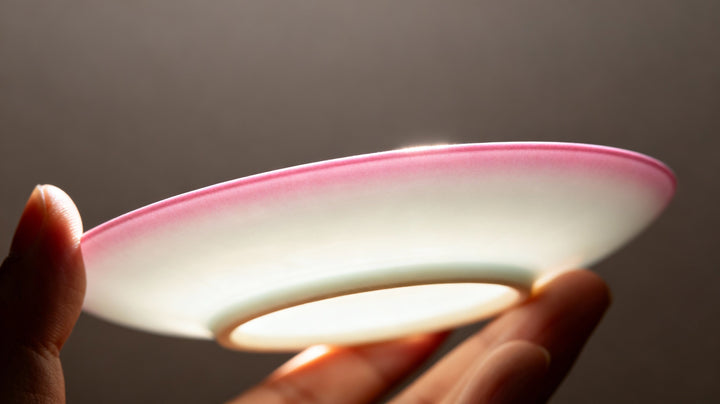
On the material side, stoneware is praised in market research for its durability and heat retention, with a pleasantly rustic weight that many households love for everyday use. Porcelain is lighter, bright white, and more refined yet still practical. Bone china is thin, translucent, and associated with fine dining.
If you map stereotypes onto those descriptions, it is easy to see how a heavy stoneware dinner plate might be framed as robust and masculine, while a thin, translucent porcelain plate is marketed as elegant and feminine. That framing can limit who feels “allowed” to enjoy which material, even though ergonomics and lifestyle are the more relevant criteria.
Tradition, Matching Sets, And The Rise Of Mix-And-Match
The Victorian idea that respectability requires a single matching dinner set has softened considerably. Today’s dinnerware trend coverage describes a strong shift toward mix-and-match personalization. Consumers buy smaller sets, supplement them with open-stock pieces, and create eclectic combinations of artisanal, hand-thrown plates with reactive glazes, minimalist neutral bowls, and the occasional metallic-rimmed statement piece.
Premium brands explicitly design collections to speak to different expressions of self. One European manufacturer frames its 2025 collections around individualization and urbanization. Some lines cater to expressive maximalists with loud colors and unusual shapes that can be rearranged into sculptural centerpieces. Others appeal to subtle individualists with quiet white porcelain reliefs and coupe shapes that signal connoisseurship without shouting.
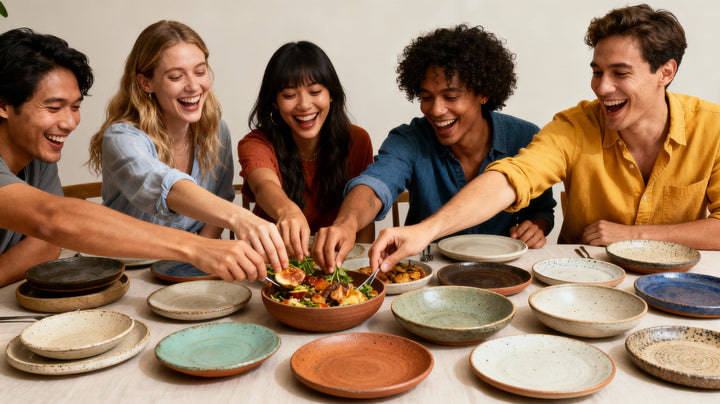
This mix-and-match movement has enormous potential to dissolve rigid gender scripts. Instead of “his” and “hers” sets, you can have a joyful ceramic wardrobe that anyone in the household reaches for based on mood, dish, or occasion. The same deep green stoneware bowl that cradles a hearty stew on Tuesday can cradle a bright citrus salad on Thursday without changing its identity.

Designing With Or Against Gender Stereotypes: Pros And Cons
To make this concrete, imagine different design and buying strategies and what they might do.
Design Strategy |
Potential Benefits |
Potential Drawbacks |
Strongly gender-coded collections |
Immediately legible gifts, easy storytelling (“his and hers,” baby boy/girl sets) |
Reinforces stereotypes, can exclude non-binary people, and ages poorly as norms shift |
Softly gendered but flexible pieces |
Allows some traditional symbolism while offering mix-and-match options |
Still carries implicit messages; may subtly steer users into old patterns |
Explicitly gender-neutral aesthetics |
Signals inclusivity, suits mixed households and modern values |
Requires more creative marketing than “for him/for her”; some consumers attached to tradition may resist |
Highly personalized mix-and-match |
Empowers individual taste, reduces gender policing of choices |
Can overwhelm buyers without guidance; risk of visual chaos if not curated thoughtfully |
From a brand perspective, hospitality and market research suggests that consumers, especially younger ones, increasingly value sustainability, uniqueness, and inclusivity. Gen Z-focused analyses point out that this generation prefers gender-neutral and culturally inclusive designs and is quick to reward brands that take ethics and representation seriously.
From a household perspective, gender-neutral or deliberately mixed dinnerware collections can be a small but tangible way to align your table with your values and relieve invisible pressure on who should eat what and how.

Practical Ways To Create A More Inclusive, Joyful Table
Let’s bring this down from theory to your actual cupboards, carts, and restaurant tabletops.
For Home Cooks, Hosts, And Everyday Eaters
Start by noticing who uses what. During your next week of meals, pay attention to which bowls and plates each person reaches for without prompting. Do certain colors or sizes cluster around particular genders or ages in your household? Even that simple observation can be revealing.
Anchor choices in ergonomics rather than expectation. Japanese guidance on chopstick length based on hand size points in the right direction. Instead of buying “men’s” and “women’s” pieces, think about hand size, grip comfort, and the kinds of dishes you actually cook. A heavier stoneware mug might be delightful for someone who loves the weight and warmth, regardless of gender, while another person may need a lightweight porcelain mug to avoid wrist strain.
Mix visual codes intentionally. If you love florals, pair them with deep blues or charcoal pieces to blur feminine and masculine signaling. If your household tends to default to big plates for men and small bowls for women, rotate who gets what for a few weeks. Let the person with the biggest appetite, not the gender, claim the generous dinner plate.
Question inherited rituals. Meoto-style pairings can be lovely if both partners enjoy them, but you can reinvent the symbolism. Choose two bowls that differ not by size but by glaze or texture, and frame them as “yin and yang” or “weekday and weekend” instead of “husband and wife.”
Involve everyone in choosing new pieces. When it is time to refresh your set, ask each person, including kids, what plates and bowls feel good in their hands and appealing to their eyes. You may be surprised by how often their raw preferences cut across stereotypes once you give them permission.
Most importantly, treat your table as a stage for shared joy rather than compliance with an invisible script. When everyone can reach for any bowl without side-eye or commentary, you reduce the emotional load on the person who is already doing most of the cooking and cleaning.
For Brands, Makers, Restaurants, And Retailers
If you design or buy dinnerware at scale, your choices shape not just one home but thousands. The research above offers clear guidance.
First, acknowledge that dishes carry gender impressions. The semantic priming study with young adults shows that dish design can implicitly cue gendered responses. Use that power consciously rather than accidentally reinforcing narrow norms. For example, instead of putting all smaller plates in pastel “ladies’ brunch” collections, design compact, stackable pieces in versatile palettes that make sense for tiny apartments, tapas, or kid-friendly portions, regardless of who uses them.
Second, widen your visual storytelling. Hospitality surveys show diners care deeply about tableware aesthetics and are willing to pay more for premium, visually distinctive experiences. Use that appetite to showcase diverse, gender-inclusive imagery: tables with mixed-gender groups using the same collection, men joyfully plating desserts on pastel dishes, women sharing hearty meals in robust stoneware, non-binary diners at the center of the scene rather than the edge.
Third, line up your values. Market analysis indicates that sustainability and ethical production are now key purchase criteria. Gen Z preference reports emphasize biodegradable or recycled materials, fair labor, and long-lasting pieces. Aligning with those priorities pairs beautifully with inclusive design. A gender-neutral, organically shaped stoneware plate with a speckled glaze can signal eco-conscious values and universal appeal in one stroke.
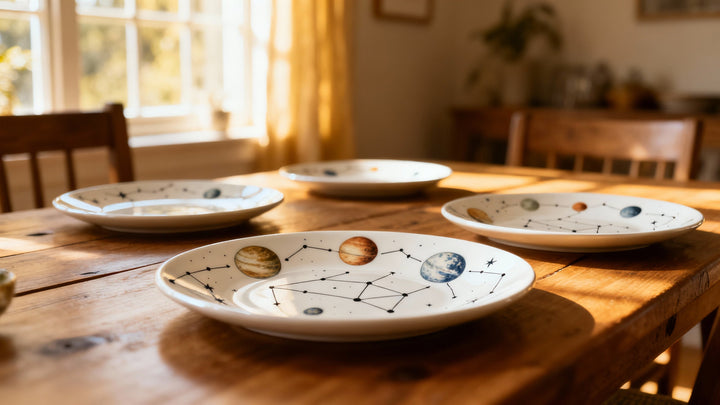
Fourth, rethink product categories and labeling. Move away from “his and hers” sets, “bachelor” plates, or gendered color names. Instead, organize by function and feeling: stackable studio sets, generous family platters, serene weekday bowls, celebration-ready metallic rims. The same goes for kids. Rather than defaulting to pink and blue dish sets tied to stereotyped characters, offer palettes inspired by nature, space, animals, or abstract art.
Restaurants and bars can experiment with breaking the script too. Swap the typical “feminine dessert plate” and “masculine main-course slab” for an eclectic mix that supports the menu and concept rather than the stereotype. Use the data showing that diners love distinctive, Instagram-friendly tableware to build experiences that feel playful and inclusive instead of gendered and predictable.
Finally, listen. Time-use and household labor research shows that unequal chores drive stress and conflict. The person who is mostly responsible for kitchen clean-up will notice if your plates chip easily, stack poorly, or require hand-washing because of delicate metallic rims. Bringing those users into the design and selection process, and compensating them for their expertise, is not just ethical; it is good business.

FAQ: Quick Answers About Gender And Dinnerware
Is it bad to love traditionally “feminine” or “masculine” dinnerware? Not at all. The goal is not to shame anyone out of their favorite floral teacup or heavy black bowl. The issue is when those styles become rules about who is allowed to enjoy what. If you love a certain look, embrace it—and make sure others feel free to love it or leave it without being judged.
Do gender stereotypes around plates really matter compared with bigger issues? On their own, plates will not fix wage gaps or caregiving policies. But research on chores and cooking shows that small, daily experiences shape stress, self-image, and relationship dynamics. Tableware is part of that everyday script. Using it to support equality and self-expression can be a surprisingly powerful micro-shift, especially when paired with bigger structural changes.
How can I tell if a brand is reinforcing stereotypes? Look at both imagery and language. If marketing consistently shows women serving and men consuming, or if palettes and shapes are narrowly tied to binary gender labels, that is a clue. Pay attention to how kids’ ranges are framed and whether non-binary or gender-fluid customers are acknowledged. Brands that emphasize ergonomics, lifestyle, sustainability, and mood over gender are usually more aligned with inclusive values.
A table can be a tiny thing or a transformative space. Every time you choose a plate, you are choosing a story about who belongs, who cooks, who is celebrated, and who is expected to serve. When you let go of gendered scripts and build a table that welcomes every hand to every bowl, you do more than set a mood. You curate a daily ritual of colorful, pragmatic joy—one ceramic choice at a time.

References
- https://pubmed.ncbi.nlm.nih.gov/22349777/
- https://docs.iza.org/dp16852.pdf
- https://thecityremains.org/tag/tableware/
- https://www.frontiersin.org/journals/psychology/articles/10.3389/fpsyg.2018.01330/full
- https://www.nber.org/system/files/working_papers/w18964/w18964.pdf
- https://www.accio.com/business/home_trends_square_dinnerware
- https://www.joyye.com/info-detail/consumer-preferences-in-ceramic-dinnerware-styles
- https://www.lemon8-app.com/nkaebabie/7441152955224736312?region=us
- https://malacasa.com/blogs/news/porcelain-dinnerware-youth-trends?srsltid=AfmBOopweYNefHooKgrSojZH5WEHSGRb3Pb-zEKE5labJIDByHfFVnsz
- https://www.restaurantware.com/blogs/tablescape-and-display-tips/why-gen-z-cares-about-tableware?srsltid=AfmBOopcNNl6kCVu781gw9ES0Er9hzSkZavNLTUdW_w7RmW1hoZMcEhU