

Ceramic dinnerware is never just ceramic. It is a stage where identity, appetite, beauty, and belonging all show up at once. In a world where more people identify as gender-fluid, nonbinary, or simply “not into labels,” that stage deserves a glow-up too.
As a colorful tabletop obsessive and pragmatic joy curator, I have watched guests relax, laugh louder, and eat more comfortably the moment the table stops whispering “ladies’ food” over here and “man-sized portions” over there. Plates may not speak, but they absolutely send messages.
This article is your guide to choosing ceramic dinnerware that keeps the joy of color and craft, while letting gender norms quietly exit the room.
Why Gender Belongs in a Conversation About Plates
Anthropology and food studies have been saying it for years: what we eat and how we present it is never just about hunger. An anthropology guide on gender, class, and food consumption from Fiveable describes how women are often linked to “healthy” and appearance-focused foods, while men are coded toward hearty, meat-heavy meals and larger portions. Food doubles as a gender performance.
A BroadAgenda article on gendered food choices shows the same pattern in everyday drinks and meals. Men worry about looking “feminine” if they order a fruity cocktail in a martini glass; women feel pressure to choose salads or lighter dishes, especially on dates or in mixed company. Research shared via PubMed Central backs this up: in a high-powered experiment with adults imagining dates versus dinners with friends, women leaned toward smaller, “feminine” foods in dating scenarios, while men’s preferences for “masculine” options, like meat-heavy plates, intensified in certain social settings.
Other studies hosted on ScienceDirect go further and show that dishes themselves, not just the food, carry gendered expectations. Young Japanese adults implicitly rated low-fat foods like salad as more feminine and high-fat dishes like breaded pork cutlets as more masculine. When those foods were plated on different dishes, the plate design nudged how feminine or masculine the same food seemed.
If culture can assign gender to salad, steak, and even the bowl they sit in, then tableware is absolutely a gender conversation. The good news is that gender fluidity gives us tools to rewrite that script in a more joyful, inclusive way.
A Short History of Gendered Eating and Tableware
From “Dainty” Plates to “Hearty” Portions
Gendered food did not fall from the sky. Historical work cited in BroadAgenda’s coverage of gender and food notes that in the late nineteenth and twentieth centuries, U.S. advertisers and cookbooks began to carve a clear line: women were encouraged toward “dainty” foods—salads, jellies, sweets, tiny sandwiches—while men were steered toward meat, hearty stews, and spicy dishes. This was heavily tied to diet culture and the ideal of a slim, feminine body.
Those scripts still echo today. Women report being judged for ordering a rare steak on a date, or for going back for seconds at workplace buffets. Men, in contrast, can still eat oversized burgers without much social penalty. Studies of real restaurant behavior summarized on ScienceDirect and PubMed Central show that on dates, women often choose less expensive, more “feminine” options, while men strategically order pricier dishes as a form of status signaling.
Dinnerware quietly props up this performance. When the only small plates have delicate florals and the only giant platter looks like a steakhouse ad, the table itself becomes a casting director for gender roles.
“His and Hers” Bowls in Japan
Japanese ceramics offer a beautifully specific example. A feature from Tsukushi-Japan traces how tableware evolved with gendered expectations from the Edo period onward. Larger, sturdier bowls were designed for men—especially samurai and workers assumed to have “hearty appetites”—while smaller, more delicate bowls served court ladies and noblewomen. The size difference shows up clearly in rice and soup bowls, where men’s bowls are often more than one‑third larger.
There is also the meoto jawan, or “husband and wife bowls”: paired rice bowls where the husband’s is bigger and the wife’s smaller. These sets are popular wedding gifts and symbols of harmony, but they also enshrine unequal appetites into the physical objects of daily life.
Chopsticks were sized by gender too. Traditional guidelines recommended around 9.1 in for men and 8.3 in for women. Contemporary practice in Japan is more relaxed, emphasizing comfort over strict rules, yet many families still instinctively buy longer “men’s” chopsticks and shorter “women’s” ones.
Color and motifs echo the same story. According to Tsukushi-Japan, men’s bowls often favor deep blues, greens, blacks, and understated patterns, while women’s bowls lean into pinks, reds, creams, and florals. For infants, ceremonial lacquerware for boys might emphasize bold vermilion and irises; girls’ sets favor black exteriors with vermilion interiors and delicate flower bouquets.
None of this is inherently bad; it is cultural history. The question for a gender-fluid moment is whether “his bowl bigger, her bowl smaller” still fits the lives we are designing at the table.
Glasses, Dishes, and Hidden Gender Signals
Recent hospitality research, summarized via ScienceDirect, shows that even the shape of a cocktail glass can carry gender. Stems often read as delicate and “feminine,” while squat, heavy tumblers feel more “masculine.” Men who worry about looking feminine may avoid stemmed glasses even if they love what is inside.
Similarly, a study of young Japanese adults on ScienceDirect showed that dish design can alter the perceived gender of a food. A salad on a pastel, floral plate reads differently from the same salad on a bold, minimal, dark plate.
Put all of this together and it becomes clear: dinnerware does not just hold food. It holds centuries of gendered expectation.

What Gender Fluidity Brings to the Table
The term genderfluid, as summarized in research on Etsy’s genderfluid mugs, describes a gender identity that is not fixed and may shift over time. People who are gender-fluid might feel more feminine on some days, more masculine on others, or outside that spectrum entirely.
Crucially, clothing and objects themselves do not have gender. A guide to nonbinary wedding attire from The Knot spells this out clearly for fashion: garments are just fabric; the gender comes from how culture chooses to read them and how people use them to express themselves. If this is true for suits and gowns, it is doubly true for plates and bowls.
Gender-fluid perspectives invite us to do three things at the table.
First, separate objects from identities. A pink salad plate does not have to belong to a woman, and a stoneware ramen bowl does not have to belong to a man. Anyone can choose whatever feels right for their appetite, mood, and expression that day.
Second, value self-definition over assumptions. Just as inclusive language resources highlight gender-neutral titles like Mx. and encourage asking “What title do you prefer?”, a gender-fluid table invites, “What bowl do you like?” instead of silently assigning the smaller portion to the woman or the colorful mug to the queer guest.
Third, design flexibility and play into the system. Research on Gen Z tableware preferences from Restaurantware shows that younger diners treat plates and cups as part of their personal brand, mixing vintage and modern, minimalist and maximalist, and favoring gender-neutral, globally inspired designs. They also care about sustainability, ethical production, and mental health–supportive, tactile pieces that make meals feel like mini rituals.
A gender-fluid tabletop pulls all of this together: it is expressive but not prescriptive, colorful but not coded, inviting but not assuming.

Design Principles for Gender-Fluid Ceramic Dinnerware
Start with the People, Not the Place Settings
Before getting lost in glaze charts, zoom out. Who is actually using these plates, and under what constraints?
Anthropology work summarized by Fiveable and the Journal of Ethnic Foods reminds us that women still carry a disproportionate burden of food preparation and serving in many households, while lower-income families face time poverty, food deserts, and limited budgets. A gender-fluid dinnerware strategy that requires buying four different curated sets for every mood is not liberation; it is just more labor and cost.
Instead of chasing perfection, think in sequences. First, clarify your reality: maybe you share a small apartment kitchen with limited cabinet space, or maybe you host big, mixed-gender friend dinners twice a month, or maybe you manage a café looking to refresh its ceramic line. Then choose dinnerware that loosens gender constraints without tightening financial or storage ones.
It is okay if your path involves secondhand plates from thrift stores, mismatched bowls inherited from relatives, and a few intentional new pieces that act as anchors. Gen Z’s approach, highlighted by Restaurantware, is instructive here: blend vintage and modern, cheap and special, rather than chasing a single “perfect” set.
Shape and Size: Liberating Appetites
Across cultures, smaller plates and bowls have been aimed at women. In Japan, as Tsukushi-Japan explains, women’s rice bowls are historically smaller and more delicate. In Western contexts, women are expected to eat smaller portions; multiple studies summarized via PubMed Central and BroadAgenda show that women are judged more harshly for eating big, high-calorie meals, especially in public or romantic settings.
Ceramic design can either reinforce or disrupt this pattern.
Here is one way to rethink shapes and sizes through a gender-fluid lens.
Aspect |
Traditional coding |
Gender-fluid approach |
Bowl capacity |
Larger for men, smaller for women |
Offer a range of sizes and never assign them by gender |
Plate diameter |
Big “dinner plates” linked to hearty male portions |
Medium, generous plates available to everyone |
Rims and depth |
Deep “manly” bowls for stews, shallow “ladies’” plates for salad |
Choose versatile forms that suit many foods regardless of who uses them |
In practice, this could look like stocking two or three bowl sizes and letting guests or family freely choose their own. When you set the table, you might deliberately mix sizes instead of automatically pairing the largest bowls with the men. If you are designing or buying for a restaurant, you can test whether your “light” dishes really need noticeably smaller plates, or whether a shared plate sizing scheme feels more dignified for everyone.
There are pros and cons to each choice. Smaller plates can reduce food waste and storage space but risk signaling that certain bodies should take up less room. Larger plates feel indulgent and flexible but may encourage over-serving if you are not careful. A gender-fluid approach accepts that appetites are individual, not gender-coded, and uses a mix of sizes without mapping them onto masculinity and femininity.
Color and Pattern: Beyond Pink and Navy
Tsukushi-Japan’s overview shows that color-coded bowls—muted blues and blacks for men, reds and florals for women—are still common in ceremonial and gift sets. Meanwhile, consumer products like rainbow “gender equality” porcelain plates sold through large online retailers lean heavily into pride symbolism for explicitly queer-themed tableware.
Color can be joyful, but it can also be a trap if it turns into a new set of rules. Some people who are gender-fluid will love plates that echo the genderfluid flag; others will feel more affirmed by a stormy indigo glaze or a mossy green speckle that has nothing to do with any flag at all.
The Knot’s guidance on nonbinary wedding attire offers a helpful parallel: clothing itself has no gender, so guests are encouraged to mix elements that feel right—tailored trousers with a sheer blouse, or a gown with combat boots. Applied to ceramics, this suggests a palette that is rich and varied, not locked into pink-for-someone and navy-for-someone-else.
One strategy I use at colorful yet gender-fluid tables is to let colors travel. The same saturated coral mug that one guest uses for coffee might later hold a sauce at a more formal dinner. The inky blue pasta bowls might cradle fruit at breakfast and noodles at night, regardless of who is at the table. Over time, people stop seeing a fixed line between “girly plates” and “boyish mugs” and start seeing a playful spectrum.
The pros of this approach are emotional freedom and visual delight. The main con is that it can feel less immediately “organized” than strict color-coding, especially to guests used to traditional gendered sets. Clear communication through place cards or a quick “pick whichever bowl you like” invitation helps bridge that gap.
Texture and Finish: Comfort as a Design Value
Research shared by Restaurantware about Gen Z’s tableware habits points out that tactile, aesthetic pieces support mental health and mindful eating. Handmade ceramics with soft curves, speckled glazes, and soothing colors become part of a slow-living ritual, not just a vessel.
From a gender-fluid perspective, texture and finish offer a quiet way to shift focus away from gender performance toward sensation. A matte, hand-thrown plate that feels like a smooth stone in your hand is not “for men” or “for women”; it is for anyone whose nervous system relaxes when they touch it. A glossy, jewel-toned coupe plate can feel opulent to a macho grill-master and a nonbinary artist alike.
Here are some trade-offs to consider. Matte finishes often hide scratches and fingerprints better and can feel grounded, but some glazes may stain more easily if they are very porous. High gloss surfaces are easy to wipe and can look luminous under candlelight, but they also magnify greasy fingerprints and chips. In a gender-fluid framework, these become practical questions, not aesthetic hierarchies tied to masculinity or femininity.

Mix, Do Not Segregate: Building a Non-Binary Set
Nonbinary wedding attire guides suggest breaking outfits into elements—tops, bottoms, layers, accessories—and remixing them into looks that feel authentic. Apply the same logic to plates.
Instead of buying rigid “his and hers” sets, think in modules: dinner plates, side plates, shallow bowls, deep bowls, mugs, and a few generous share platters. Within each category, mix a couple of patterns or colorways that look good together but do not scream “paired opposites.” A speckled off-white plate, a midnight blue plate, and a muted rose plate can happily coexist, and anyone can use any of them.
Over time, your table stops sorting people into pairs and starts displaying a palette of options. Guests will mix and match on their own. Gender-fluid diners, in particular, often appreciate being able to choose a different “feeling” plate on different days, just as they might choose different clothes or pronouns depending on mood and context.
If you gift tableware—say for a wedding—consider meoto-style symbolism with a twist. Instead of a larger and smaller “husband and wife” bowl, choose two bowls that differ in shape, color, or glaze, but not in status. They are companions, not a hierarchy. Add a note that invites the couple to decide who uses which bowl on any given day, or to swap freely.
Practical Scenarios: Gender-Fluid Choices in Real Life
Everyday Meals in a Gender-Expansive Home
Imagine a household with roommates or partners who identify across the spectrum: cis, trans, gender-fluid, questioning. Breakfast is rushed; dinner is often shared. In this context, practical matters—dishwasher safety, stackability, cost—sit right beside emotional safety.
Start by standardizing the basics at a level that feels easy. A set of medium-sized, stackable stoneware plates in a calm neutral or earth tone keeps daily meals low-drama. Add expressive pieces around them: a few deeply colored noodle bowls, some playful salad plates, one or two hand-painted platters that show up when energy allows.
The key is to let use dictate choice. A roommate who is feeling “small” one day might gravitate toward a compact bowl of soup; on an exuberant day, they might pile up curry on a big plate. No one sighs or swaps plates for them to keep appearances. Over time, the table becomes like a wardrobe: a collection of options, not a binary.
The anthropological work published as “Dietary practices and gender dynamics: understanding the role of women” reminds us how often women eat last or least in patriarchal households. A gender-fluid ceramic strategy pushes back by making it normal for any person, regardless of gender, to reach for the most generous bowl if they are hungry.
Hosting Guests Across the Gender Spectrum
Hosting carries extra charge because presentation is more performative. Studies on restaurant ordering in dating and family contexts, summarized on ScienceDirect, show that people lean into gender-typical food choices most strongly on dates, less with friends, and least with family. Your table can either amplify that anxiety or soften it.
When I host mixed-gender or queer-heavy dinners, I pay special attention to first impressions. As guests arrive and see the table, I want their bodies to think, “This place sees me.” That might look like:
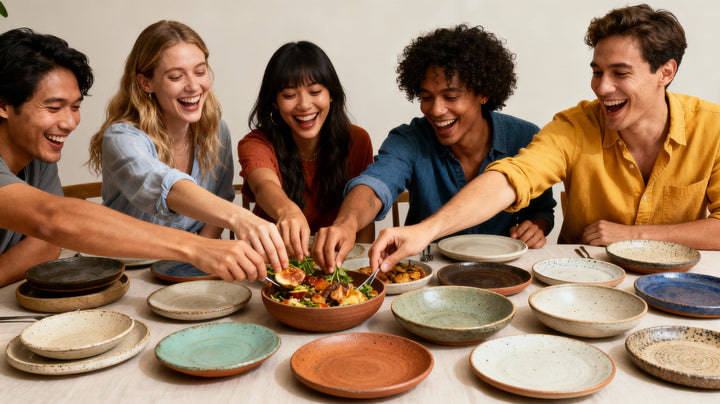
Plates and bowls of similar status at every seat, rather than tiny salad plates at some spots and large dinner plates at others. Share platters placed centrally so everyone reaches together, not in a pattern that maps “protein near the men, vegetables near the women.” Glassware that avoids coding, such as sturdy stemless glasses for all or a range of stems and tumblers placed randomly so guests can choose.
The nonbinary attire advice from The Knot about balancing respect for the event with authenticity is useful here too. You can honor a formal occasion with ceramic quality and cohesive colors while still breaking gender scripts in sizing and placement.
If you use name cards, consider inclusive titles drawn from gender-neutral honorifics highlighted by language-inclusion resources: Mx., or no title at all. Some hosts like to place small pronoun indicators at seats; pronoun enamel pins, like those described in inclusive-language articles, can even double as take-home gifts clipped to napkins.
Curating a Gift Registry or Retail Collection
If you are building a registry as a gender-fluid or nonbinary couple, or if you design or buy for a retail collection, you have a chance to set new defaults.
A registry that leans into gender fluidity might foreground mix-and-match clay bodies and glazes instead of rigid, gendered sets. It might highlight sustainable, ethically made ceramics that align with Gen Z values documented by Restaurantware, such as biodegradable or recycled materials, and small-artist production. It might also explicitly avoid labeling things as “his and hers,” opting instead for descriptive names like “sunrise cereal bowl” and “midnight pasta plate.”
Stores can signal inclusivity by photographing all genders using a variety of pieces, not just men with heavy stoneware and women with pastel porcelain. Storytelling copy can focus on comfort, texture, sustainability, and self-expression rather than gender. Inspiration can come from queer and trans-owned brands in the fashion and home space, much like the queer-owned tailoring houses and inclusive clothing brands recommended by The Knot for wedding attire.

Materials, Ethics, and Access: Who Gets to Have a Gender-Fluid Table?
Gender justice and food justice are always intertwined. The Journal of Ethnic Foods article on gender dynamics notes that women often lack control over land, credit, and resources even while they do most of the food work. Fiveable’s overview highlights how lower-income households are pushed toward processed foods by time pressure and limited access to fresh ingredients. Urban agriculture and community-based initiatives are recommended to close the gap.
Ceramic dinnerware sits at the consumption end of that system. Choosing artisan-made plates does not fix structural inequality, but a gender-fluid approach that also cares about affordability and ethics can help.
Here are some directions that align with both gender fluidity and access, without pretending dinnerware alone is a solution. Mix high and low. Combine a few cherished, possibly more expensive, handmade ceramic pieces with sturdy, budget-friendly basics from big-box stores or secondhand shops. Focus on durability. Gender-fluid tables welcome everyone, including kids, elders, and guests who gesticulate wildly with their forks. Tough stoneware that survives drops is quietly inclusive. Support diverse makers. When possible, source from women, queer, and Indigenous ceramicists whose practices honor cultural knowledge and environmental limits, echoing calls from UBC’s work on food, identity, and Indigenous culinary traditions.
Importantly, do not make “gender-fluid dinnerware” a luxury niche. The goal is not to replace “his and hers” with “ours, but only if you make above a certain income.” The goal is to normalize flexible, non-binary, joyful tableware at every price point, from thrift-shelf finds to heirloom pieces.

Quick Comparison: Gendered vs Gender-Fluid Dinnerware
Here is a snapshot of how a table can shift when you look through a gender-fluid lens.
Dimension |
Gendered dinnerware setup |
Gender-fluid dinnerware setup |
Bowl and plate size |
Larger pieces quietly reserved for men |
Multiple sizes, freely chosen by anyone |
Color palette |
Dark, muted for men; light, floral for women |
Mixed palette with no gender assigned to any color |
Sets and pairing |
“His and hers” sets, meoto-style hierarchy |
Companion pieces with equal status, different only in aesthetics |
Glassware |
Sturdy tumblers for men; stemmed glasses for women |
A mix of glass shapes offered to all, no default assignments |
Marketing language |
“Masculine stoneware,” “feminine florals” |
Focus on texture, mood, sustainability, story—not gender |
Guest experience |
Some feel boxed in; appetites policed |
All guests free to choose what fits their hunger and identity |

FAQ
Does gender-fluid dinnerware mean I have to buy rainbow plates?
Not at all. Pride-themed pieces, like rainbow equality porcelain plates or genderfluid-flag mugs, can be powerful and fun, but gender fluidity at the table is more about freedom than about any one motif. A deeply textured oatmeal-colored plate can be just as gender-fluid as a rainbow one if no one is told it “belongs” to a particular gender.
How do I talk about this with relatives who prefer traditional “ladies’” and “men’s” sets?
Start with comfort and hospitality, not ideology. You can explain that you want everyone to feel free to eat what they need and to use whatever dish feels good in their hands. You might keep a few heirloom “ladies’ plates” in rotation for sentimental reasons while also casually mixing in more neutral, flexible pieces. Over time, many people adjust more easily than you expect when they feel the meal itself is caring and delicious.
Ceramic dinnerware will never be neutral, and that is the magic. It holds stories, rituals, and politics in its curves and glazes. When you choose plates and bowls with gender fluidity in mind, you are not just decorating a table—you are quietly telling everyone who sits there, “All of you is welcome here, and there is more than enough room.”

References
- https://pmc.ncbi.nlm.nih.gov/articles/PMC10311548/
- https://sciences.ucf.edu/anthropology/wp-content/uploads/sites/2/2013/09/Persaud_Donald.pdf
- https://www.researchgate.net/publication/394334437_Shaken_Stirred_And_Stereotyped_Glassware's_Hidden_Influence_on_Gender_Perceptions_and_Order_Intentions
- https://smart.dhgate.com/how-to-use-respectful-and-inclusive-titles-alternatives-to-mr-and-mrs-for-non-binary-people/
- https://www.etsy.com/market/genderfluid_mug
- https://thefoodschool.com/food-vs-gender-fluidity/
- https://www.theknot.com/content/nonbinary-wedding-attire
- https://www.amazon.com/Gender-Differentiation-Identity-Rainbow-Porcelain/dp/B08SCC1757
- https://journalofethnicfoods.biomedcentral.com/articles/10.1186/s42779-021-00081-9
- https://www.broadagenda.com.au/2024/the-surprising-way-your-gender-influences-your-food-choices/