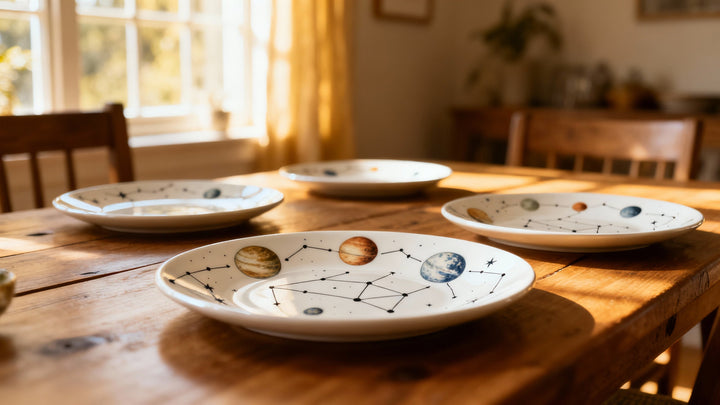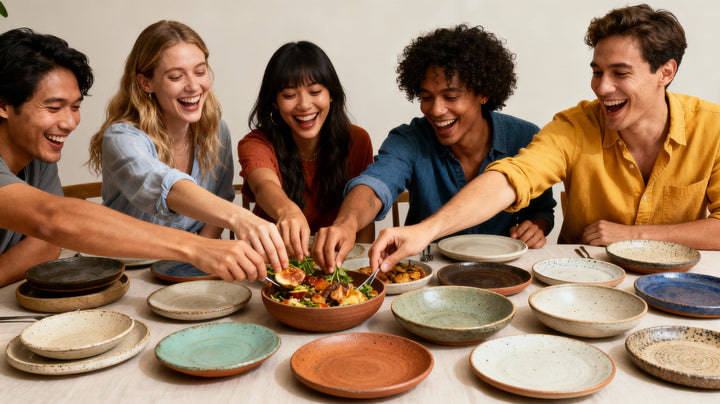


A Tiny Plate with a Planet-Sized Impact
Children eat several times a day. That means plates, bowls, and cups show up in their lives more often than storybooks or favorite shoes. Every sip of milk and swirl of spaghetti is a chance to practice habits that either strain the planet or help it breathe a little easier.
Early childhood experts who write for organizations such as BrightPath Kids, Sustainable Living Association, Project Learning Tree, and the National Environmental Education Foundation keep repeating the same theme: sustainability for kids sticks best when it is woven into ordinary, joyful routines. Families are encouraged to use reusable bottles instead of disposables, to compost kitchen scraps together, to label recycling bins with pictures, to walk or bike for short trips, and to turn off lights and taps while they talk about why it matters. The most powerful lessons happen in real life, not in abstract lectures.
Children’s ceramic tableware can be one of those real-life teaching tools. A small plate becomes more than a dish; it becomes a daily, colorful reminder that we choose reusables over throwaways, care over convenience, and creativity over clutter. As a Colorful Tabletop Creative and Pragmatic Joy Curator, I like to think of every kid-sized bowl as a tiny billboard for the kind of future we are designing.
In this article, we will look at what “sustainable” really means in the context of children’s ceramic tableware, how to design and produce it responsibly, how to use it to teach eco-conscious habits, and what trade-offs to consider compared with other materials. Throughout, we will stay grounded in what reputable environmental educators are already doing with families and classrooms, then translate those insights into practical steps for product development and design.

What Sustainability Means at the Kids’ Table
Project Learning Tree highlights two widely used definitions of sustainability. The United Nations frames it as meeting present needs without compromising the ability of future generations to meet theirs. The US Environmental Protection Agency describes it as maintaining conditions under which humans and nature can exist in productive harmony.
When we shrink those big ideas down to the size of a cereal bowl, sustainability in children’s tableware becomes about three everyday questions.
Are we using resources wisely over the life of the product, from raw materials to shipping box to end-of-life?
Are we reducing waste and pollution compared with realistic alternatives in the same context?
Are we helping children and caregivers build habits that respect limited resources, rather than encouraging use-and-toss behavior?
Environmental groups working with kids repeatedly emphasize the classic “reduce, reuse, recycle” sequence. Sustainable Living Association, for example, explains that reducing consumption and reusing items often has more impact than recycling alone. Hennepin County’s family-focused guidance stresses cutting single-use items, buying used when possible, and treating food waste as a major environmental issue in household trash. GoHenry and Ecomena underscore that plastic does not biodegrade in any reasonable timeframe and contributes heavily to global waste.
A sustainable approach to children’s ceramic tableware design leans into that hierarchy. The core job of a cup or plate is to be used again and again, replacing a long trail of paper plates, plastic trays, or novelty snack packs. The role of the designer and manufacturer is to make that repeated use safe, durable, emotionally appealing, and gentle on the planet at every stage.
From Eco Buzzwords to Everyday Behaviors
Environmental educators agree on something else: sustainability has to feel doable and even fun. BrightPath Kids describes eco-conscious parenting as a practice of consistent, manageable choices that fit regular routines. Project Learning Tree warns against overwhelming children with doom, suggesting instead that educators emphasize positive examples and concrete actions. The National Environmental Education Foundation promotes distance-learning “adventures” that make topics like wetlands and climate change feel exciting rather than depressing.
Children’s tableware sits right in this sweet spot. It can turn big environmental ideas into tiny, repeatable behaviors.
A child who knows that the plate in front of them will be washed and reused for years begins to see reusability as normal. A set of color-rich bowls that always return to the cupboard after the dishwasher cycle can quietly reinforce the three Rs as behavior, not slogan.
Families already practicing sustainability emphasize similar patterns. Sustainable Living Association encourages parents to talk about where trash goes, to visit farmers’ markets, to compost food scraps, and to adopt one new eco-friendly habit each month so change feels playful, not punitive. Ecomena suggests that children help design home recycling systems and even join a “plastic patrol,” spotting single-use plastic and choosing alternatives like bamboo cups, wooden brushes, and metal or ceramic containers when shopping.
Children’s ceramic tableware can be designed to support exactly that “plastic patrol” mindset. When a child reaches instinctively for the “forever plate” instead of a disposable one, an invisible victory has already happened.

Design Principles for Sustainable Children’s Ceramic Tableware
Durability and Reuse as the Heart of Sustainability
Across almost all the family and classroom resources in the research notes, one idea appears in different disguises. The most sustainable object is the one you use many times instead of throwing away.
BrightPath Kids talks about reusable water bottles, cloth grocery bags, and DIY toys built from old boxes. Hennepin County encourages families to skip disposable water bottles and paper napkins. Sustainable Living Association and GoHenry both emphasize that repurposing and reusing items combats the global mountain of waste, which Ecomena and GoHenry note has reached billions of tons a year.
Ceramic tableware fits beautifully into this reuse-first logic if it is designed to survive real family life. That means thinking beyond studio-shelf beauty to daycare-table toughness.
Edges and rims need to be robust enough for everyday bumps. Surfaces should handle frequent washing without the design fading. Shapes should stack securely in crowded kitchen cabinets so the set stays intact rather than slowly losing pieces in daily chaos. The goal is not delicate gallery pieces, but charming workhorses that toddlers will outgrow before the tableware wears out.
From a sustainability lens, every extra year of use is a quiet win. Each time a ceramic snack plate replaces a paper plate or a plastic tray, emissions and waste from that alternative are avoided, even though we may not see the exact numbers in daily life.
Safe, Kid-Centered Geometry
Environmental educators like those writing for Playto and Take Care of Texas emphasize hands-on interaction. Children plant seeds, churn compost buckets, and carry recycling to bins. In those activities, objects are picked up, dropped, and used imperfectly, which is exactly how young children handle dishes too.
So ergonomic, child-centered shapes matter for both safety and sustainability. Plates with slightly raised, rounded rims help contain food and reduce spills, which in turn helps reduce food waste. Bowls that are shallow enough for small spoons but deep enough to feel “grown-up” encourage kids to serve themselves more confidently, which aligns with Hennepin County’s advice to teach kids simple, concrete habits like pouring only as much water as they plan to drink.
Handles and grips matter as well. A small mug with an easy-to-grab handle can make it less likely that a child switches to a thin disposable cup at daycare or a party. When tableware feels secure in little hands, it is more likely to stay in rotation rather than being sidelined as too fragile or fussy.
Color, Story, and Emotional Attachment
One of the liveliest threads running through the sustainability-for-kids articles is the insistence on joy. CleanChoice Energy describes nature bingo, lightning bug spotting, and backyard camping. GoHenry and Sustainable Living Association recommend movies, books, and creative crafts that make environmental caring feel exciting. Project Learning Tree encourages activities that help students explore viewpoints and lifestyles, not just rules.
Children’s ceramic tableware can tap into the same emotional toolkit. Color palettes, motifs, and narratives can turn a simple plate into a character in the child’s sustainability story.
A bowl with vegetables and garden bugs can connect directly to family gardening and compost themes. This echoes the advice from both BrightPath Kids and Sustainable Living Association to grow herbs or vegetables with children and show how food comes from soil, not store shelves. A cup decorated with clouds and rain can be a visual prompt for water conservation conversations like those suggested by Ecomena, which recommends showing children what a gallon of water looks like and talking about how much water an average person uses.
When a child falls in love with a particular plate or cup, they instinctively want to keep it, protect it, and use it again. That emotional attachment is a quiet but powerful sustainability feature, because it resists the constant churn of novelty and disposability.
Portion-Smart Shapes and Food Waste Awareness
Multiple sources in the research notes call out food waste. Sustainable Living Association urges families to “think before you toss,” suggests freezing surplus produce, and encourages composting. Hennepin County points out that food waste is the largest stream of material in American household trash and links meat-heavy diets with higher greenhouse gas emissions, encouraging at least one meatless day each week.
Children’s tableware design can support those goals by making it easier to serve appropriate portions and to deal with leftovers responsibly.
Smaller plate areas and bowl volumes give kids permission to take modest first servings and then return for more if they are hungry. Visual cues like subtle rings or color shifts in the ceramic can suggest what a “try-it” portion looks like versus a full serving, turning the plate into a gentle teacher.
Flat areas or wide rims can make it easy for kids to help scrape leftovers into a compost container, mirroring the classroom compost buckets described by Take Care of Texas. When children participate in that end-of-meal ritual, they see that uneaten food has a place in the cycle instead of disappearing into a black-box trash can.

Life Cycle Practices for Planet-Minded Ceramic Development
Sourcing and Production Through a Conservation Lens
While the research notes focus more on household and classroom behavior than on factory floors, the same principles apply. Ecomena and GoHenry stress that resources like water and raw materials are limited and that everyday choices about consumption matter. Hennepin County cites the US Environmental Protection Agency’s estimate that a family of four uses about 400 gallons of water each day, which is one reason family-oriented guidance includes turning off taps and shortening showers.
In a ceramic tableware studio or factory, that kind of water awareness can translate into simple but meaningful practices. Rinse water can be collected and allowed to settle so cleaner water can be reused in earlier stages of production instead of going straight down the drain. Clay trimmings can be reclaimed and recycled into new pieces rather than becoming solid waste. Production batches can be planned to minimize energy-intensive re-firings.
Although the research notes do not provide specific statistics for industrial processes, they send a clear message: the same creativity we bring to compost buckets and classroom gardens can be applied to how we handle clay, water, and electricity in manufacturing.
Packaging and Shipping That Align with the Message
Several sources emphasize cutting down on unnecessary packaging and single-use materials. Sustainable Living Association highlights that explaining where trash goes and practicing the three Rs helps children see the consequences of packaging waste. Hennepin County urges families to avoid single-use cups, bottles, and baggies. Custom Earth Promos (via the Cloudflare-guarded article described in the notes) is clearly focused on reusable, lower-impact products, even though the specific tips are not fully accessible here.
For children’s ceramic tableware, this means packaging should look and feel as considered as the product itself. Boxes made primarily from recycled cardboard, inner protection from shredded paper or reusable fabric wraps, and clear icons explaining how to recycle or reuse each material fit neatly with the guidance families are already receiving from sustainability educators.
Shipping choices matter too. Articles like those from GoHenry and Sustainable Living Association talk about “food miles” and the impacts of frequent online shopping with excessive packaging. Manufacturers and retailers can respond by consolidating shipments when possible, offering slower, grouped shipping options, and encouraging customers to add only what they genuinely need rather than padding carts with impulse buys.
Designing for Long-Term, Flexible Use
Another recurring pattern in the notes is the encouragement to buy used goods and to see possessions as durable rather than disposable. Hennepin County explicitly recommends buying secondhand items and highlights that doing so reduces the resources required to manufacture, package, and distribute new ones. Sustainable Living Association and various classroom-focused resources emphasize reusing materials, from jars as plant pots to cardboard as art supplies.
Children’s ceramic tableware can amplify that mindset by being designed for a long life and flexible roles. A small bowl that works just as well for applesauce at age two as for trail mix at age eight will stay useful longer than something styled only for a narrow developmental window. Neutral but playful geometric patterns can grow with the child better than heavily branded characters that feel babyish in just a year or two.
This flexibility increases the chances that, when one child outgrows a set, it moves to a sibling, cousin, or thrift store rather than to the trash. That aligns perfectly with the donation and reuse culture praised by Sustainable Living Association, Ecomena, and GoHenry, all of which encourage families to donate clothing, toys, and household goods instead of discarding them.

Using Ceramic Tableware to Teach Sustainability
Turning Mealtimes into Micro-Lessons
Many of the articles in the research notes point to everyday teaching moments. BrightPath Kids suggests labeling recycling bins with pictures so toddlers can join in. Sustainable Living Association encourages families to adopt one eco-friendly practice each month and to talk about where trash and recycling go. Playto and Take Care of Texas describe classroom activities where children plant seeds, maintain small gardens, and manage compost buckets.
A child’s plate can be part of those conversations in simple, age-appropriate ways. During dinner, a parent might point out that this plate is washed and reused every day, while a paper plate would be thrown away after just one meal. That naturally ties into the “reduce, reuse, recycle” sequence children see in school posters and storybooks like the ones recommended by GoHenry, such as titles that explain trash, recycling, and making a better world.
The key is to keep it light, as Project Learning Tree suggests. Mealtimes can feature quick remarks about how choosing durable dishes, eating what is on the plate, and composting leftovers fit into the same planet-caring story as walking to the park or turning off lights when leaving a room.
Linking Plates to Gardens, Bins, and Taps
Research notes from sources like BrightPath Kids, Sustainable Living Association, Ecomena, Hennepin County, and Take Care of Texas all show that kids learn best when they can see a full loop: where things come from, how they are used, and where they go afterward.
Ceramic tableware can anchor that loop. Food comes from soil and farms, as highlighted by Sustainable Living Association and BrightPath Kids, not just from grocery shelves. It lands on the ceramic plate or in the bowl, becomes part of the child’s body when eaten, and the leftovers are scraped into a compost container rather than into general trash. Plates are rinsed with an eye on water use, echoing the guidance from Ecomena and Hennepin County to avoid leaving taps running and to treat water as a limited resource.
Even simple rituals can reinforce these ideas. For instance, families might let children be the official “compost captain” after dinner, or the “water saver” who reminds others not to let the faucet gush. CleanChoice Energy and the National Environmental Education Foundation both highlight the value of giving children responsibility in environmental activities; a brightly glazed plate can be one of their favorite “tools” for that job.
Bringing Classroom Sustainability Home
Classroom-focused resources such as the activity collections described by GetAlma and Project Learning Tree show how teachers are turning sustainability lessons into year-round practice with herb gardens, energy audits, trash-sorting games, and eco-themed art projects.
Children’s ceramic tableware can complement those efforts at home. A plate decorated with leaves and animals can tie into nature walks, scavenger hunts, and wildlife-watching described by organizations like CleanChoice Energy. Bowls with simple icons for compost, recycling, and trash can echo the labeled bins children see at school, reinforcing sorting habits in both settings.
Families might even adopt small games that mirror classroom activities. One evening per week could feature a “zero-waste dinner” challenge where kids help plan portions to minimize leftovers and then proudly report how little ended up in the compost bucket. This connects directly with Hennepin County’s reminders about how much water and energy go into daily life and with Sustainable Living Association’s encouragement to treat eco-friendly living as an ongoing project, one new habit at a time.

Ceramic vs Other Kids’ Tableware Materials: A Quick Comparison
Here is a high-level comparison that reflects themes in the research notes, especially around reusability, plastic reduction, and habit-building. It is not an exhaustive technical analysis, but a way to organize practical considerations.
Aspect |
Children’s ceramic tableware |
Plastic-heavy children’s tableware |
Reusability and lifespan |
Designed for repeated use over many meals when cared for, supporting the “reduce and reuse” priorities emphasized by Sustainable Living Association and Hennepin County. |
Often reusable but sometimes treated as semi-disposable because it is inexpensive and easily replaced, which can dull children’s sense that objects should last. |
Waste and end-of-life |
Does not flex into microplastics; broken pieces become inert solid waste, and long service life can offset the impact of production. |
Ecomena and GoHenry highlight that plastic does not biodegrade and can persist in the environment, contributing to the massive global waste load they describe. |
Teaching value |
Tangible symbol of “forever” objects, ideal for teaching that some things are meant to be washed and reused, echoing the family habits encouraged by BrightPath Kids and others. |
Can be used to start “plastic patrol” conversations, but if overused, may conflict with messages about reducing single-use plastics and choosing alternative materials like bamboo, metal, or ceramic. |
Sensory experience |
Weight, coolness, and color depth can make meals feel special and encourage mindful eating, which ties into food-waste conversations and garden-to-table stories. |
Lighter weight and more forgiving when dropped, which is convenient, but may feel more like toyware or takeout packaging, depending on design. |
Perceived fragility |
Needs thoughtful design to feel robust enough for everyday child use; when successful, helps kids practice careful handling of valued objects. |
Often perceived as unbreakable, which can reduce stress but may also encourage rougher handling and a disposable mindset if pieces are easily replaced. |
The research notes consistently emphasize that no single material choice solves sustainability on its own. What matters most is how a product is used, how long it lasts, and what patterns of behavior it encourages. Ceramic tableware shines when it is part of a broader family and classroom culture that values reuse, careful consumption, and joyful responsibility.

A Practical Design Checklist in Question Form
When I design or review a new children’s ceramic collection through a sustainability lens, I like to frame the work as a series of questions rather than a strict checklist. This mirrors the reflective style promoted by Project Learning Tree, which encourages students to consider viewpoints and lifestyle choices rather than memorizing rules.
The first question is whether this product will genuinely replace disposables or low-quality items in real families’ lives. If a plate is so precious that parents keep it in a cabinet “for special,” it is not reducing everyday waste.
The second question is whether the material and form will withstand actual use in homes and classrooms that are busy, loud, and imperfect. This is where the durability and child-friendly geometry discussed earlier come into play.
The third question is how the design supports the teaching moments environmental educators describe. Does it make it easier to serve reasonable portions, to compost leftovers, to talk about where food comes from and where waste goes, to practice water conservation at the sink?
The fourth question is what story the project tells about consumption. Does the branding quietly encourage collecting many sets and styles, or does it celebrate a small number of beloved, long-lived pieces that move with the child through different stages and even into new homes?
The fifth question is whether packaging, shipping options, and after-care information line up with the values already promoted by organizations like BrightPath Kids, Sustainable Living Association, and Hennepin County. Instructions about washing, repairing chips where appropriate, and donating sets that are still in good condition can nudge families toward the reuse and sharing culture seen across the research notes.
When those questions are answered with honesty and creativity, a children’s ceramic line can become a practical ally for parents and educators already working hard on compost systems, recycling games, water-saving habits, and nature-based play.
FAQ: Children’s Ceramic Tableware and Sustainability
Is ceramic tableware really sustainable for kids, given that it can break?
The research notes show that sustainability educators prioritize reduction and reuse over simply swapping materials. Ceramic is sustainable in a children’s context when it is designed and managed in a way that supports long-term use. That means robust forms, child-centered ergonomics, and family norms around careful handling. When a ceramic plate replaces a long sequence of disposable or low-quality alternatives, it aligns well with the “use what you have, use it often” mindset described by Sustainable Living Association and Hennepin County.
How can families introduce ceramic tableware in homes that are just starting their sustainability journey?
The articles from BrightPath Kids, GoHenry, and others suggest starting small. Families might begin with one child-sized ceramic plate and bowl that are clearly presented as “forever dishes,” paired with simple changes like using reusable water bottles and turning off lights. By connecting the plate to composting leftovers, watering plants with leftover clean water, and talking about where trash goes, mealtimes become an easy on-ramp into broader eco-friendly habits without overwhelming children.
Can ceramic kids’ tableware support classroom sustainability goals?
Yes. Classroom resources from GetAlma, Project Learning Tree, and Take Care of Texas show that teachers are already using objects like plant pots, compost buckets, and art materials to teach environmental responsibility. Ceramic tableware can extend those practices into snack times and cooking activities. Plates and bowls that visually reference gardens, water, or wildlife can reinforce themes from classroom lessons, while routines around washing dishes, scraping leftovers into compost, and discussing food waste can turn every school snack into an opportunity to practice stewardship.

Bringing It All Together at the Colorful Kids’ Table
Sustainable children’s ceramic tableware is not just about clay and glaze; it is about shaping habits, stories, and tiny daily decisions. Environmental educators from BrightPath Kids to the National Environmental Education Foundation are already helping families and schools compost, recycle, conserve water and energy, and choose reusables over disposables. When we design kids’ ceramics that are durable, enchanting, and easy to live with, we give those lessons a joyful home on the table.
The next time you sketch a bowl, choose a color palette, or review packaging for a new line, imagine a child proudly setting that dish down, scraping leftovers into a compost bucket, turning off the tap, and running outside to tend a small garden. That is the kind of bright, pragmatic magic a well-designed plate can spark, and it is exactly the kind of everyday artistry our planet needs.

References
- https://files.peacecorps.gov/documents/PC_Environmental_Activities_508_mNd3UVx.pdf
- https://sph.edu/blogs/environmental-awareness-for-students/
- https://americanspcc.org/eco-friendly-parenting-teaching-kids-sustainable-choices-for-a-greener-future/
- https://www.earthsharenj.org/25-fun-ways-to-teach-kids-sustainability-and-green-habits/
- https://www.ecomena.org/teach-sustainable-living-to-kids/
- https://prowellness.childrens.pennstatehealth.org/10-eco-friendly-activities-for-kids-to-celebrate-world-environment-day/
- https://sustainablelivingassociation.org/7-ways-to-encourage-kids-to-be-more-environmentally-friendly/
- https://articles.unishanoi.org/sustainability-for-kids/
- https://www.neefusa.org/what-we-do/k-12-education/environmental-education-activities
- https://www.biologicaldiversity.org/programs/population_and_sustainability/sustainability/live_more_sustainably.html